
Thyroid cancer symptoms most often start with a lump at the front of the lower neck that usually feels hard, is not painful and slowly gets bigger. Other signs include a hoarse voice that does not improve, trouble swallowing or breathing, pain or pressure in the front of the neck, and swollen lymph nodes on the side of the neck. Many thyroid cancers cause no symptoms at all, and most neck lumps turn out to be harmless, but any new or growing lump should be checked by a doctor.
Source: NHS, American Cancer Society, Cleveland Clinic
Source: American Cancer Society, NCI SEER, American Thyroid Association
Contents
- Thyroid cancer symptoms: why they are easy to miss
- The 8 most common thyroid cancer symptoms
- Thyroid nodule or cancer? What a neck lump can tell you
- Thyroid cancer symptoms by type
- Thyroid cancer symptoms vs other thyroid problems
- Who is at higher risk of thyroid cancer
- When thyroid cancer symptoms need a doctor
- How a suspicious lump is investigated
- Screening, overdiagnosis and slow-growing cancers
- Treatment and outlook after diagnosis
- Frequently asked questions
Thyroid cancer symptoms: why they are easy to miss
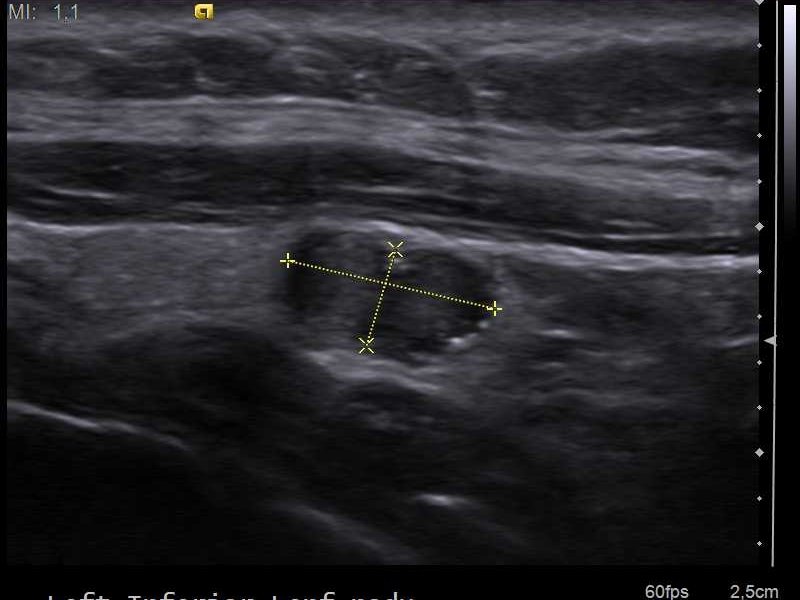
The thyroid is a butterfly-shaped gland at the front of the neck, below the voice box, that makes hormones controlling how the body uses energy. Thyroid cancer starts when cells in this gland grow out of control, and in its early stages it rarely makes you feel unwell, so thyroid cancer symptoms are easy to overlook. The National Cancer Institute notes that the disease may not cause early signs or symptoms at all, and Cleveland Clinic states that most thyroid cancers cause no symptoms.
Source: National Cancer Institute, Cleveland Clinic
Because thyroid cancer symptoms are often absent, many cancers are found by chance. Some people notice a lump while shaving, or a doctor feels a nodule during a routine exam, long before any other thyroid cancer symptoms appear. The American Cancer Society (ACS) points out that early thyroid cancers are also sometimes found during imaging tests for other health problems.
Source: American Cancer Society
In the United States, the ACS estimates about 45,240 new cases of thyroid cancer in 2026, around 32,000 of them in women, and about 2,320 deaths. Roughly 1.1% of people will be diagnosed with it during their lifetime. Because it often affects people in their 30s to 60s, thyroid cancer symptoms are worth knowing well before old age.
Source: American Cancer Society, NCI SEER
The 8 most common thyroid cancer symptoms
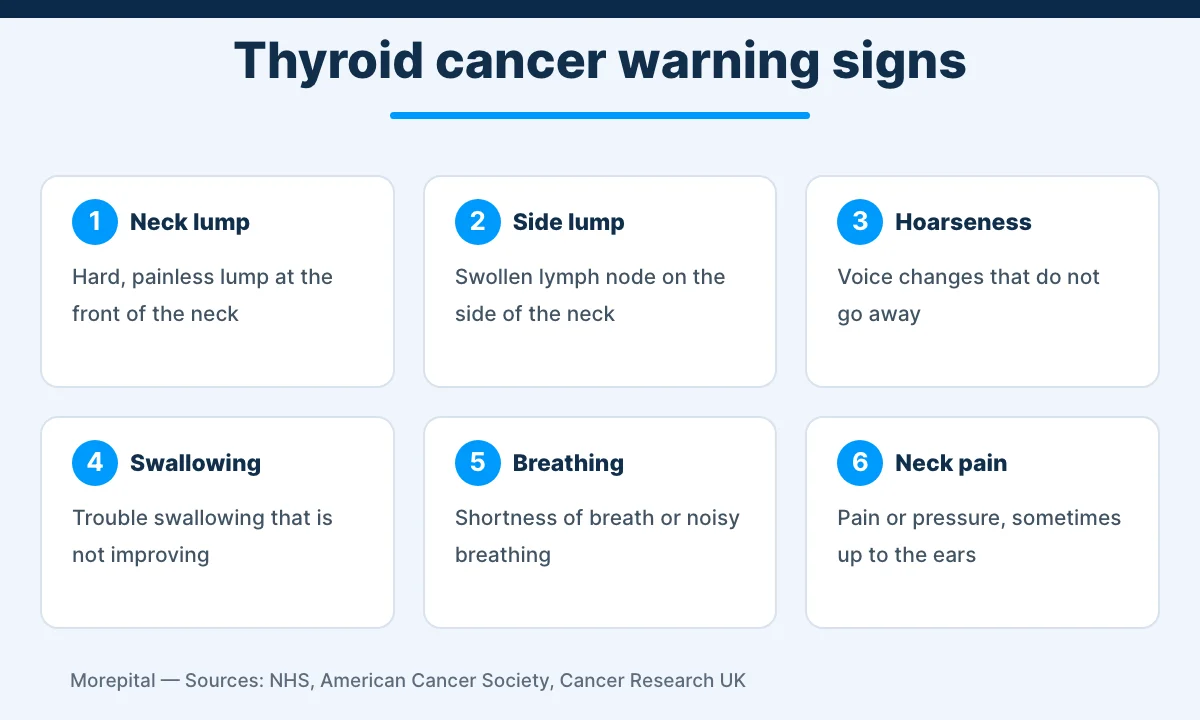
When thyroid cancer symptoms do appear, they come mainly from a growing tumor pressing on the windpipe, the food pipe (esophagus) or the nerves that control the vocal cords. The main signs are:
- A lump at the front of the neck. This is the most common sign. It sometimes grows quickly.
- Swelling in the neck. The whole front of the neck may look fuller.
- A lump on the side of the neck. This is often a lymph node the cancer has spread to.
- Hoarseness or other voice changes that do not go away and have no obvious cause.
- Trouble swallowing that is not getting better.
- Trouble breathing, or noisy breathing, when a tumor presses on the windpipe.
- Pain or pressure in the front of the neck, sometimes spreading up to the ears.
- A constant cough that is not caused by a cold.
Source: American Cancer Society, NHS, Cancer Research UK
The NHS also lists some less common thyroid cancer symptoms: flushing (a red face, which may be harder to see on brown or black skin), softer stools or diarrhea, weight loss and a cough. A lasting cough and hoarseness can also come from lung or throat conditions, which our guide to lung cancer symptoms covers in more detail. Thyroid cancer symptoms like these are common and have many possible causes, so having one does not mean you have cancer.
Source: NHS, American Cancer Society
Thyroid nodule or cancer? What a neck lump can tell you
A thyroid nodule is any lump within the thyroid gland. Nodules are extremely common: the American Thyroid Association (ATA) says that by age 60 about half of all people have a thyroid nodule that can be found by examination or imaging, and over 90% of these nodules are benign. Cleveland Clinic gives a similar figure, estimating that only about 1 in 10 nodules is cancerous.
Source: American Thyroid Association, Cleveland Clinic
Benign causes include goiter, fluid-filled cysts and adenomas. The ACS notes that solid nodules are more likely to be cancer than fluid-filled ones, though most are still benign, and nodules that make excess thyroid hormone are almost always benign.
Source: American Cancer Society
Features that make doctors look more closely
The ATA says it is usually not possible to tell whether a lump is cancer from an exam and blood tests alone. The NHS describes the typical cancerous lump as hard, slowly growing and painless. Cancer Research UK advises checking any neck lump, painful or not, and going back if a checked lump suddenly grows. A fast-growing lump, or one with other thyroid cancer symptoms such as hoarseness or breathing trouble, needs prompt assessment.
Source: American Thyroid Association, NHS, Cancer Research UK
Thyroid cancer symptoms by type
The type of tumor affects which thyroid cancer symptoms are likely, how fast they develop and how the disease is treated:
| Type | Share of cases | Typical behavior and symptoms |
|---|---|---|
| Papillary | About 8 in 10 | Slow-growing, usually in one lobe; painless lump; may spread to neck lymph nodes but is often treatable |
| Follicular | About 1 in 10 | More common with low-iodine diets; rarely in lymph nodes but can reach the lungs or bones |
| Oncocytic (Hürthle cell) | About 3% | Harder to detect and treat |
| Medullary | Less than 5% | Starts in calcitonin-making C cells; may cause flushing and diarrhea; about 1 in 4 cases inherited |
| Anaplastic | About 2% | Spreads quickly; fast-growing hard neck mass with voice, swallowing or breathing problems |
Source: American Cancer Society, Cancer Research UK
Papillary and follicular: the slow, quiet types
The National Cancer Institute describes these well-differentiated cancers as usually curable. When they cause thyroid cancer symptoms, these tend to build over months or years: a lump that slowly enlarges, then perhaps a side-of-neck lymph node. Cleveland Clinic notes that papillary and follicular cancers have excellent 5-year survival even after spreading.
Source: National Cancer Institute, Cleveland Clinic
Medullary: flushing and loose stools
Medullary thyroid cancer is a neuroendocrine tumor that begins in the C cells, which make the hormone calcitonin. Cancer Research UK explains that when these cells make too much calcitonin, some people get unusual thyroid cancer symptoms such as frequent loose bowel movements and flushing (going red in the face).
Source: Cancer Research UK, National Cancer Institute, American Cancer Society
Anaplastic: rare but urgent
Anaplastic thyroid cancer is rare and often develops from an existing papillary or follicular cancer. A published case review describes it as typically presenting with a rapidly enlarging neck mass, usually more than 5 cm (2 inches) across, that is fixed and hard, often with hoarseness, difficulty swallowing, shortness of breath or cough. More than 90% of patients are older than 50. Any neck lump that grows noticeably over a few weeks should be seen urgently.
Source: Journal of Clinical and Diagnostic Research (PMC), American Cancer Society
Thyroid cancer symptoms vs other thyroid problems
Many people expect thyroid cancer to cause an underactive or overactive thyroid. In fact, the ATA explains that thyroid function tests are most typically normal, even when cancer is present. The tumor usually sits inside a gland that keeps working normally, so the classic hormone-related complaints are not reliable thyroid cancer symptoms.
Source: American Thyroid Association
If your main complaints are fatigue, weight changes or palpitations, read our separate guide to thyroid symptoms, which covers hypothyroidism, hyperthyroidism and goiter. The two can overlap, though: a person with an underactive thyroid can also develop a nodule, and new thyroid cancer symptoms such as a lump still need checking.
Source: American Thyroid Association, NHS
Who is at higher risk of thyroid cancer
Thyroid cancer is almost 3 times more common in women than in men, for reasons that are not clear. Unlike most adult cancers, it is often diagnosed at a younger age; the ACS says it is most common in people in their 30s through 60s, and risk peaks earlier in women than in men. Other recognized risk factors include:
- Childhood radiation to the head or neck, or radioactive fallout such as Chernobyl in 1986; risk rises with dose and younger age at exposure.
- Family history of thyroid cancer in a parent, sibling or child, although most patients have none.
- Inherited syndromes, including MEN2 (linked to RET gene changes and medullary cancer), familial adenomatous polyposis, Cowden syndrome and Carney complex.
- Excess body weight: risk appears to rise as body mass index (BMI) increases. Our reference page on obesity explains how BMI is measured.
- Iodine intake: follicular cancer is more common where diets are low in iodine, while high iodine intake may raise papillary cancer risk.
- A history of goiter.
Source: American Cancer Society, National Cancer Institute, Cleveland Clinic
Having a risk factor does not mean you will get cancer, but it is a reason to report thyroid cancer symptoms promptly. For families with known medullary thyroid cancer, the ACS says most doctors recommend genetic testing at a very young age; if a gene change is found, removing the thyroid gland can prevent many of these cancers.
Source: National Cancer Institute, American Cancer Society
When thyroid cancer symptoms need a doctor
Health services do not set a fixed waiting period for thyroid cancer symptoms; what matters is whether they persist, change or worsen. Book an appointment with your doctor (GP or primary care physician) if you notice:
- a lump in your neck, painful or not, or a known lump that suddenly gets bigger
- a hoarse voice that is not getting better
- difficulty swallowing that is not getting better
- pain at the front of your neck or a feeling of pressure there
Source: NHS, Cancer Research UK
Get help faster if you have difficulty breathing or are more short of breath than usual: the NHS advises an urgent GP appointment or NHS 111, and elsewhere you should contact a doctor the same day. These symptoms are common and do not definitely mean cancer, but finding cancer early may make it easier to treat.
Before the appointment, write down when your thyroid cancer symptoms started, whether a lump has changed size, any past head or neck radiation and any relatives with thyroid cancer. Tracking new body changes helps with other cancers too, such as the lumps described in our guide to breast cancer symptoms.
Source: American Cancer Society, Cancer Research UK
How a suspicious lump is investigated
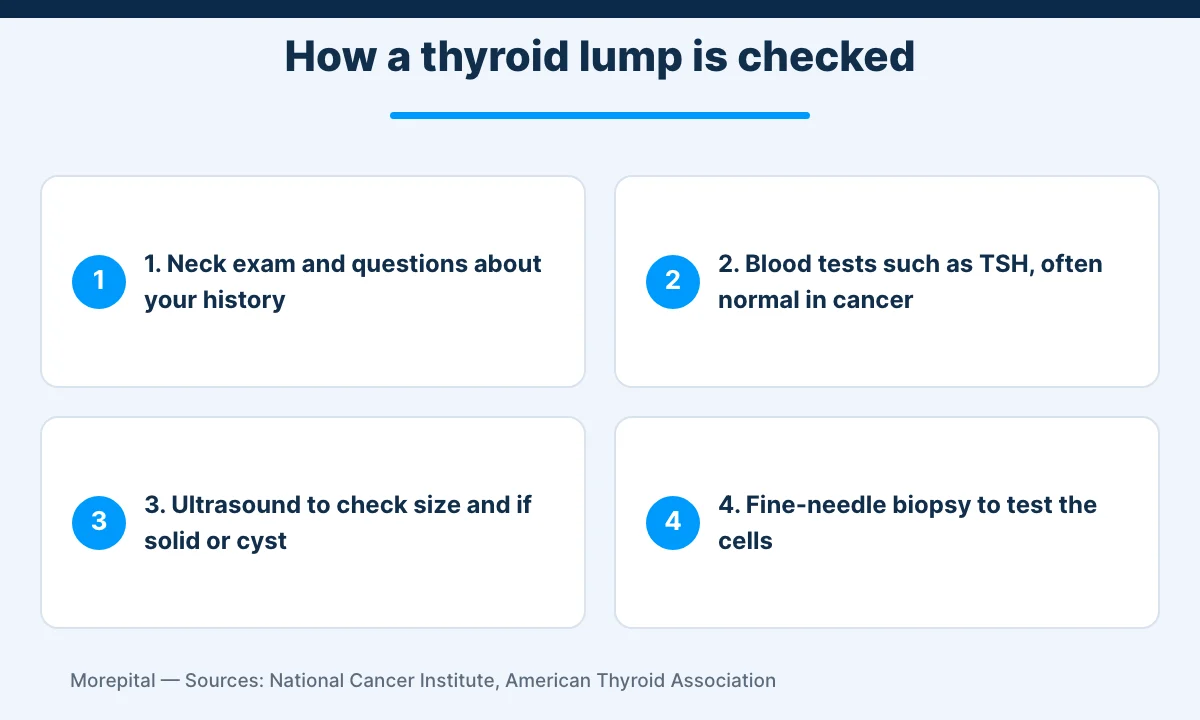
When thyroid cancer symptoms or a nodule need checking, doctors usually follow these steps:
- Exam and history. The doctor checks the neck and lymph nodes and asks about thyroid cancer symptoms and risk factors.
- Blood tests, usually TSH and sometimes calcitonin, a marker for medullary cancer. Normal results do not rule out cancer.
- Ultrasound, which shows a nodule’s size and whether it is solid or a cyst.
- Fine-needle aspiration (FNA) biopsy, usually ultrasound-guided and done in the clinic, often without local anesthetic.
- Laryngoscopy. A view of the voice box shows whether the vocal cords move normally.
- Further imaging, such as CT, to check how far a confirmed cancer has spread.
Source: National Cancer Institute, American Thyroid Association
Understanding biopsy results
The ATA reports that up to 80% of thyroid biopsies are benign, about 5% show cancer (mostly papillary), “suspicious” results carry a 50% to 75% cancer risk, and up to 20% are indeterminate. When a biopsy is unclear, the National Cancer Institute notes that a surgical biopsy removing the nodule or one lobe may be used.
Source: American Thyroid Association, National Cancer Institute
Screening, overdiagnosis and slow-growing cancers
Unlike breast or cervical cancer, there is no routine screening program for thyroid cancer. In 2017 the US Preventive Services Task Force recommended against screening adults without thyroid cancer symptoms (a grade D recommendation), concluding that overdiagnosis and overtreatment are likely harms. The ACS adds that no major professional organization recommends routine screening for most people, although doctors may consider it for those at higher risk.
Source: US Preventive Services Task Force, American Cancer Society
Many tiny papillary cancers never grow enough to cause harm: autopsy studies cited by the Task Force found them in about 11.5% of glands. In South Korea, ultrasound screening pushed diagnoses to 15 times the 1993 rate by 2011 while deaths stayed stable, and an International Agency for Research on Cancer (IARC) study estimated that more than 1 million people in 26 countries may have been overdiagnosed in 2008 to 2012.
Source: US Preventive Services Task Force, IARC (WHO)
In the US, after stricter diagnostic criteria, incidence fell by about 1.4% per year from 2013 through 2022, while the death rate has stayed about the same since 2009. Real thyroid cancer symptoms should always be checked, but a small nodule found by chance may simply be monitored with ultrasound.
Source: American Cancer Society, National Cancer Institute
Treatment and outlook after diagnosis
Surgery is the most common treatment: the surgeon removes one lobe (lobectomy) or the whole gland (thyroidectomy), sometimes with nearby lymph nodes. Other options include radioactive iodine (not used for medullary cancer), thyroid hormone tablets, external radiotherapy, targeted drugs for advanced disease, rarely chemotherapy, and watchful waiting in selected cases.
Source: NHS, National Cancer Institute
Surgery can cause temporary or permanent hoarseness if the vocal cord nerves are irritated or damaged, and low blood calcium (muscle spasms, numbness or tingling) if the parathyroid glands are affected. The ACS notes that complications are less likely with an experienced thyroid surgeon. After a total thyroidectomy, you will need thyroid hormone tablets such as levothyroxine for life.
Source: American Cancer Society, Cleveland Clinic
Once thyroid cancer symptoms lead to a diagnosis, the outlook is among the best of any cancer. US SEER data show 5-year relative survival of 98.3% overall: 99.9% when confined to the thyroid, 98.1% with spread to nearby lymph nodes and 48.3% with distant spread. Cleveland Clinic notes that about 2 in 10 papillary cancers come back, so long-term follow-up matters.
Source: NCI SEER, Cleveland Clinic
Thyroid cancer symptoms: frequently asked questions
What are usually the first thyroid cancer symptoms?
The first of the thyroid cancer symptoms is usually a painless lump at the front of the neck, often found by chance. Hoarseness or trouble swallowing tend to come later, if at all.
Source: Cleveland Clinic, NHS
Can you have thyroid cancer with no symptoms?
Yes. Many tumors cause no thyroid cancer symptoms and are found during a routine exam or a scan for another reason.
Source: National Cancer Institute, American Cancer Society
Is pain one of the thyroid cancer symptoms?
Sometimes. Cancerous lumps are typically painless, but neck pain or pressure can occur, and doctors advise checking any lump, painful or not.
Source: Cancer Research UK, American Cancer Society
Do thyroid cancer symptoms show up in blood tests?
Usually not. Thyroid hormone levels are typically normal in thyroid cancer, so ultrasound and a fine-needle biopsy are needed to diagnose it. Calcitonin may be raised in medullary cancer.
Source: American Thyroid Association, National Cancer Institute
Can thyroid cancer cause diarrhea or flushing?
Yes, but mainly the rare medullary type, whose cells can release too much calcitonin. These are unusual thyroid cancer symptoms and are much more often due to other causes.
Source: Cancer Research UK, NHS
How fast do thyroid cancer symptoms develop?
Most papillary and follicular cancers grow slowly over years. Anaplastic cancer is the exception: it spreads quickly and typically shows up as a rapidly enlarging neck mass.
Source: American Cancer Society, Journal of Clinical and Diagnostic Research (PMC)
Disclaimer: this article is for general health education and does not replace advice from a qualified doctor who can assess your individual case. Last updated: October 2026.