
Premature ejaculation treatment works for most men and usually starts with simple behavioral techniques, such as the stop-start and squeeze methods, combined with counseling. If that is not enough, European urology guidelines recommend on-demand dapoxetine tablets or a lidocaine/prilocaine numbing spray as first-line medicines, with daily antidepressants, PDE5 inhibitors and other options as later steps. A doctor first checks for causes such as erectile dysfunction, prostate inflammation or thyroid problems, because treating those can improve ejaculation control on its own.
Source: EAU, Cleveland Clinic, NHS
Source: Cleveland Clinic, EAU
Contents
- What premature ejaculation treatment aims to fix
- How doctors assess PE before treatment
- Behavioral techniques and self-help
- First-line premature ejaculation treatment: dapoxetine and numbing spray
- Second- and third-line medicines
- Psychosexual therapy and the partner’s role
- Procedures and unproven options
- Premature ejaculation treatment options compared
- Choosing a clinic for premature ejaculation treatment, at home or abroad
- Frequently asked questions
What premature ejaculation treatment aims to fix

Premature ejaculation is a form of sexual dysfunction in which ejaculation happens sooner than a man or his partner would like during sexual activity. An occasional quick ejaculation is normal and does not need premature ejaculation treatment. Doctors consider it a condition when it happens during all or almost all sexual encounters, causes distress to one or both partners and has lasted for at least six months to a year. It is the most common male sexual dysfunction, reported by roughly 1 in 5 men aged 18 to 59.
Source: Cleveland Clinic, NHS
The International Society for Sexual Medicine (ISSM) uses a definition with three parts. First, ejaculation always or nearly always occurs before or within about 1 minute of vaginal penetration from the first sexual experience (lifelong PE), or there is a clinically significant, bothersome drop in latency, often to about 3 minutes or less (acquired PE). Second, the man is unable to delay ejaculation on all or nearly all penetrations. Third, there are negative personal consequences such as distress, frustration or avoiding intimacy. Time alone is not enough; loss of control and distress matter just as much.
Source: J Sex Med 2014, ISSM
Lifelong vs acquired PE
Lifelong PE has been present since a man first became sexually active. Acquired PE develops after a period of normal sexual function. Men with acquired PE tend to be older and more often have erectile dysfunction and cardiovascular risk factors, so looking for an underlying cause matters more. The European Association of Urology (EAU) also describes “subjective” PE, in which a man feels he ejaculates quickly although his measured latency is normal; here premature ejaculation treatment is mostly education and reassurance.
Source: J Sex Med 2014, EAU
Why it happens
Psychological factors are the most common cause: performance anxiety, stress, relationship problems, depression, low self-esteem and past sexual trauma. Physical contributors include erectile dysfunction, an inflamed or infected prostate, thyroid disorders, other hormone and brain-chemical (serotonin and dopamine) imbalances, high penile sensitivity and recreational drug use. Many men with erectile dysfunction develop secondary PE from performance anxiety. For a full overview of the condition, see our reference page on premature ejaculation.
Source: Cleveland Clinic, NHS, ISSM, EAU
How doctors assess PE before treatment
Diagnosis is based mainly on your medical and sexual history. A doctor, often a urologist, will ask how long it has lasted, how often it happens, whether it occurs with every partner and during masturbation, and whether erections are a problem, plus your other conditions, medicines, supplements, alcohol and drug use. Being open helps the doctor choose the right premature ejaculation treatment.
Arabic-speaking readers: a detailed, source-referenced Arabic overview of this topic is available in the Alphateb medical encyclopedia — سرعة القذف.
Source: Cleveland Clinic, NHS
The EAU recommends including a physical examination in the first assessment. Your own estimate of the time to ejaculation is considered enough in routine practice; stopwatch timing is used in research. Short questionnaires such as the Premature Ejaculation Diagnostic Tool (PEDT) help: a PEDT score above 11 suggests PE. Routine blood tests are not recommended and are usually needed only when the history points to an underlying condition such as a thyroid or hormone problem.
Source: EAU, Cleveland Clinic
Treat the underlying cause first
Before any premature ejaculation treatment, the EAU gives a strong recommendation to treat erectile dysfunction, other sexual problems or a genitourinary infection such as prostatitis before targeting ejaculation itself. In one clinic group of men with both conditions, PE partly or fully resolved in 30% after erectile dysfunction was treated with a PDE5 inhibitor alone. In men with an overactive thyroid the rate of PE fell from about 50% to 15% once thyroid levels were normalized. If erections are part of the problem, our guide to erectile dysfunction treatment explains the options, and the reference page on erectile dysfunction covers its causes.
Source: EAU, Transl Androl Urol
Our article on low testosterone symptoms lists hormone signs worth raising with your doctor, and men with risk factors for diabetes can check the common diabetes symptoms, since the EAU lists diabetes among conditions associated with PE.
Source: Cleveland Clinic, EAU
Behavioral techniques and self-help
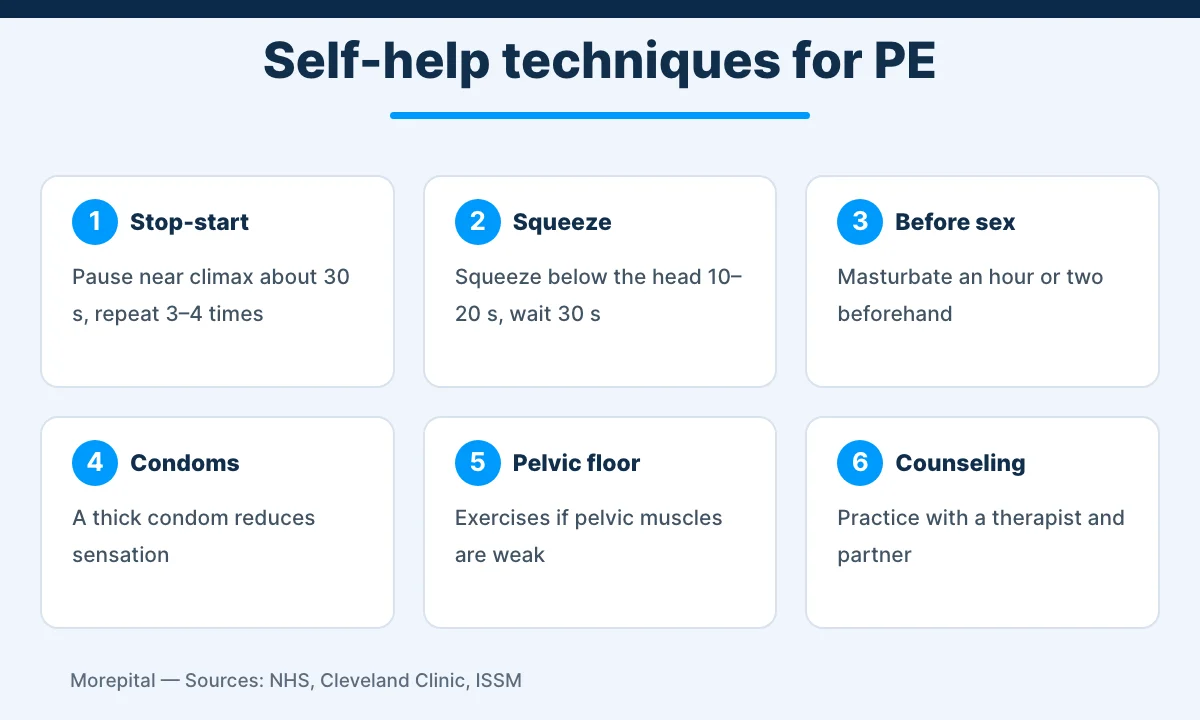
Behavioral therapy is usually the first step of premature ejaculation treatment, and many men find it the most helpful part. These techniques train you to recognize the sensations just before the “point of no return” and to lower arousal in time. This form of premature ejaculation treatment needs practice, ideally with a cooperative partner, and works best with counseling.
Source: Cleveland Clinic, NHS
The stop-start method
During masturbation or sex, stimulation is stopped when you feel close to ejaculating and resumed once the urge fades, after about 30 seconds. Cleveland Clinic describes repeating this three or four times before allowing orgasm.
Source: Cleveland Clinic, ISSM
The squeeze technique
Just before ejaculation, you or your partner squeeze the penis where the head meets the shaft for 10 to 20 seconds, then wait about 30 seconds before continuing. The NHS suggests learning this alongside psychosexual counseling.
Source: NHS, Cleveland Clinic, ISSM
Other simple measures
- Masturbating an hour or two before sex.
- Using a thick condom, or a condom combined with a local anesthetic, to reduce sensation.
- Having sex with your partner on top, so they can pull away when you are close.
- Shifting attention to non-sexual thoughts for a moment (distraction).
- Pelvic floor muscle exercises, which ISSM lists when weak pelvic floor muscles are a factor.
Source: NHS, Cleveland Clinic, ISSM
Two points matter for any premature ejaculation treatment at home. Having sex less often tends to make PE worse, because it increases sensitivity to stimulation. And although alcohol may delay orgasm, it is not a recommended treatment.
Source: Cleveland Clinic
First-line premature ejaculation treatment: dapoxetine and numbing spray
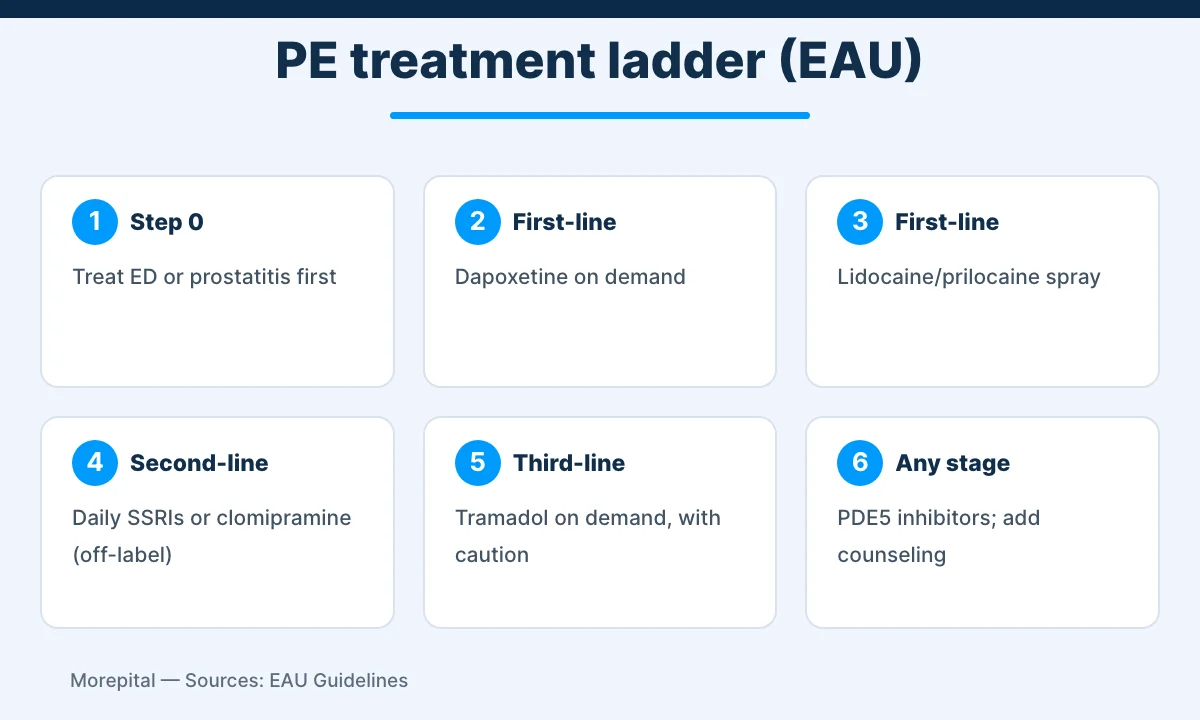
For lifelong PE, the EAU gives a strong recommendation to use either dapoxetine or a lidocaine/prilocaine spray as first-line premature ejaculation treatment. Both are taken or applied “on demand” before sex rather than every day. Dapoxetine is an SSRI designed specifically for PE, and the spray is authorized in the European Union for lifelong PE in adult men.
Dapoxetine
Dapoxetine (brand name Priligy) is a short-acting selective serotonin reuptake inhibitor (SSRI) developed for PE. The EAU describes doses of 30 or 60 mg taken 1 to 2 hours before intercourse, while the NHS states 1 to 3 hours before sex and no more than once a day; your prescriber will give the exact timing for your tablets. Common side effects include nausea, diarrhea, headache and dizziness. Fainting (vasovagal syncope) occurred in about 0.1% of men in phase III trials, so the EAU advises checking blood pressure and pulse lying and standing before starting. It is not suitable for everyone, including some men with heart, kidney or liver problems.
Lidocaine/prilocaine spray
The metered spray authorized in the EU as Fortacin contains 7.5 mg lidocaine and 2.5 mg prilocaine per spray. The dose is three sprays onto the head of the penis before intercourse, about five minutes beforehand according to the EAU, with at least 4 hours between doses and no more than 3 doses in 24 hours. The most common side effects, affecting up to 1 in 10 people, are reduced sensation and burning in the genital area in men and their partners, and erectile dysfunction. It must not be used if you or your partner are allergic to amide-type local anesthetics, and the EAU does not recommend it for couples trying to conceive.
Other numbing creams and sprays work in a similar way and usually take 10 to 30 minutes to act. Because the anesthetic can transfer to a partner and reduce their sensation, wash the penis before sex or use a condom; the NHS notes that condoms are effective, especially combined with a local anesthetic.
Source: Cleveland Clinic, NHS
Second- and third-line medicines
Daily SSRIs and clomipramine
If first-line options fail or are unavailable, the EAU recommends off-label daily SSRIs or clomipramine taken daily or on demand as second-line premature ejaculation treatment. Options include paroxetine, sertraline, fluoxetine, citalopram and escitalopram. The NHS notes that the full effect usually takes 1 to 2 weeks and that side effects such as nausea and diarrhea usually ease after 2 to 3 weeks. Clomipramine, a tricyclic antidepressant, has been studied at 15 mg taken 2 to 6 hours before sex.
Source: EAU, NHS, Cleveland Clinic
Among SSRIs, paroxetine shows the greatest effect. A 2019 meta-analysis of 19 randomized trials found that paroxetine lengthened time to ejaculation more than placebo, fluoxetine and escitalopram, while differences against sertraline, tramadol, dapoxetine, PDE5 inhibitors, lidocaine gel or behavioral therapy were not statistically significant. Paroxetine combined with tadalafil or with behavioral therapy outperformed paroxetine alone. Side effects such as headache, nausea and dizziness were mostly mild, but inconsistent definitions and short follow-up limit the evidence.
Source: BMC Urology, EAU
As a premature ejaculation treatment these antidepressants are used off-label, so they need medical supervision. The EAU advises caution in adolescents and in men with depression or suicidal thoughts.
Source: EAU
PDE5 inhibitors
PDE5 inhibitors such as sildenafil, tadalafil, vardenafil and avanafil are mainly erectile dysfunction medicines, but as a premature ejaculation treatment the EAU recommends them, alone or in combination with other therapies, for men with PE even without erectile dysfunction.
Source: EAU, Cleveland Clinic, NHS
Tramadol
Tramadol is an opioid pain medicine. The EAU lists it as an off-label, on-demand third-line option to be used with caution, and Cleveland Clinic says it is prescribed only in certain cases. It should only ever be used on a doctor’s prescription.
Source: EAU, Cleveland Clinic
Psychosexual therapy and the partner’s role
Because psychological factors are the most common cause, counseling is a core part of premature ejaculation treatment. A psychologist or sex therapist can help with performance anxiety, depression, stress or relationship difficulties; in psychosexual counseling, the therapist works with you and, if you have one, your partner to address relationship issues and to practice techniques that help “unlearn” the habit of ejaculating quickly.
Source: Cleveland Clinic, NHS
The EAU recommends combining psychological or behavioral therapies with medicines in acquired PE, and Cleveland Clinic notes that combination therapy may work better than any single treatment. Involving your partner makes the techniques easier to practice and is part of successful premature ejaculation treatment.
Source: EAU, Cleveland Clinic
Procedures and unproven options
Surgery plays almost no role in premature ejaculation treatment. The EAU gives a weak recommendation to use hyaluronic acid injections into the head of the penis only with caution, and advises against selective dorsal neurectomy, an operation that cuts sensory nerves, until more safety data are available. Circumcision is not a risk factor for PE, so it is not a treatment for it.
Source: EAU, Transl Androl Urol
Many herbal products and supplements are sold as premature ejaculation treatment, but Cleveland Clinic states that there is not enough evidence that alternative therapies work. Tell your doctor about anything you take.
Source: Cleveland Clinic
Premature ejaculation treatment options compared
The table summarizes where each premature ejaculation treatment fits, based on the EAU guideline and patient guidance from the NHS and Cleveland Clinic.
Source: EAU, NHS, Cleveland Clinic
| Option | How it is used | Place in treatment | Main drawbacks |
|---|---|---|---|
| Stop-start, squeeze, counseling | Practiced during masturbation and sex | First step for most men; combined with medicines | Needs practice and time |
| Dapoxetine | 30 or 60 mg tablet, 1–2 hours before sex (NHS: 1–3 hours) | First-line for lifelong PE | Nausea, headache, dizziness; rare fainting |
| Lidocaine/prilocaine spray | 3 sprays on the glans before sex | First-line for lifelong PE | Numbness in man or partner; not for couples trying to conceive |
| Daily SSRIs, clomipramine | Daily (clomipramine also on demand) | Second-line, off-label | Takes 1–2 weeks; nausea; caution in young men and depression |
| PDE5 inhibitors | Alone or combined | Recommended, especially with erectile dysfunction | Benefit clearest when erectile dysfunction is present |
| Tramadol | On demand | Third-line, off-label, with caution | An opioid; use only with caution |
| Hyaluronic acid, dorsal neurectomy | Injection or surgery | Caution (injection); not recommended (surgery) | Limited safety data |
Source: EAU, NHS, EMA, Cleveland Clinic
Choosing a clinic for premature ejaculation treatment, at home or abroad
Most men can start with their family doctor, who may refer them to a urologist or psychosexual therapist; others choose a specialist men’s health clinic, at home or abroad. Wherever you go, good premature ejaculation treatment should follow the same evidence: a proper history and examination, treatment of erectile dysfunction or infection first, behavioral techniques and counseling, and licensed medicines before off-label ones.
Questions to ask before you start
- Will a urologist take a full sexual and medical history and examine me?
- Will you check for erectile dysfunction, prostate inflammation and thyroid problems?
- Which medicine do you suggest, is it licensed for PE, and what are its side effects?
- Do you offer psychosexual counseling, and can my partner join?
- How will follow-up of my premature ejaculation treatment work if I live in another country?
Source: EAU, Cleveland Clinic
If you are considering care in Turkey, the Health Türkiye platform, run under the Ministry of Health, lists healthcare facilities and facilitators certified to treat international patients. Male Hospital, a specialized men’s sexual health center in Istanbul, explains the guideline-based options on its page on premature ejaculation treatment and shares practical tips on how to last longer in bed. Be cautious with any clinic that promises a permanent cure from a single procedure, because the EAU does not support surgery for PE.
Source: Health Türkiye, EAU
When to see a doctor and what to expect
See a doctor if premature ejaculation is persistent, happens frequently, causes anxiety or depression, or is straining your relationship. The outlook for premature ejaculation treatment is good: most men find relief with one or more treatments, and behavioral therapy is often the most helpful part. PE itself is not harmful, but conditions that can contribute to it, such as erectile dysfunction, chronic pelvic pain, thyroid disorders and substance use, deserve attention in their own right.
Source: Cleveland Clinic, NHS
Considering premature ejaculation treatment? Contact us for a free consultation and a treatment plan tailored to you.
Premature ejaculation treatment: frequently asked questions
What is the most effective premature ejaculation treatment?
There is no single best option for everyone. Guidelines favor behavioral techniques and counseling combined with medicines, with dapoxetine or a lidocaine/prilocaine spray as first-line drugs for lifelong PE. Combination therapy may work better than any single treatment.
Source: EAU, Cleveland Clinic
Can premature ejaculation treatment give a permanent cure?
Most men find relief with one or more treatments, and behavioral therapy is often the most helpful. On-demand medicines such as dapoxetine and numbing sprays are taken or applied before each sexual encounter, so the realistic goal is lasting control rather than a one-off cure.
Source: Cleveland Clinic, EAU
How long does premature ejaculation treatment take to work?
Numbing sprays act within minutes, and dapoxetine is taken a few hours before sex. Daily SSRIs usually reach their full effect in 1 to 2 weeks. Behavioral techniques work gradually and need regular practice.
Is a numbing spray for premature ejaculation treatment safe for my partner?
The anesthetic can transfer and cause numbness or burning in a partner. Wash the penis before sex or use a condom, and do not use these products if either of you is allergic to amide-type local anesthetics.
Source: EMA, Cleveland Clinic
Is there premature ejaculation treatment without medicine?
Yes. The stop-start and squeeze techniques, masturbating before sex, thicker condoms, pelvic floor exercises and counseling help many men, especially when practiced with a partner.
Disclaimer: this article is for general health education and does not replace advice from a qualified doctor who can assess your individual case. Last updated: October 2026.