
Hemorrhoids (also called piles) are swollen, inflamed veins in the lower rectum or around the anus that can cause bright red bleeding after a bowel movement, itching, a lump and discomfort. They are very common, especially after age 50, and most flare-ups settle within days with more fiber, fluids, gentle hygiene and less straining. Persistent or severe hemorrhoids can be treated with quick office procedures such as rubber band ligation, and surgery is needed only in a minority of cases.
Source: NIDDK, NHS, Cleveland Clinic
Contents
- What are hemorrhoids?
- Internal vs external piles and the 4 grades
- Hemorrhoids symptoms
- Causes and risk factors
- Rectal bleeding: when to see a doctor
- How piles are diagnosed
- Treating hemorrhoids at home
- Office procedures and surgery for hemorrhoids
- Prevention, including in pregnancy
- Frequently asked questions
What are hemorrhoids?

Everyone has hemorrhoidal tissue. These are soft cushions of blood vessels, connective tissue and smooth muscle that sit in the anal canal in three main columns (left lateral, right anterior and right posterior). When they fill with blood they help seal the anus, supplying an estimated 15 to 20% of the resting pressure in the anal canal and helping you stay continent when you cough, sneeze or lift. They become a problem only when the cushions swell, stretch or slip and cause symptoms.
Source: Clinics in Colon and Rectal Surgery (PMC)
The condition is extremely common. In the United States, about 1 in 20 people have bothersome hemorrhoids, and about half of adults older than 50 have them. They affect men and women of all ages. Piles range from pea-sized pink or purple lumps to grape-sized swellings, and the NHS notes that piles often get better on their own after a few days.
Source: NIDDK, Cleveland Clinic, NHS
Internal vs external piles and the 4 grades
The key landmark is the dentate line, a boundary inside the anal canal. Those above it are internal and are covered by lining that has visceral nerves, so they are usually painless. Those below it are external and are covered by anoderm, skin that contains pain fibers, which is why external piles can hurt a lot, especially when a clot forms.
Source: Clinics in Colon and Rectal Surgery (PMC)
Internal hemorrhoids
Internal hemorrhoids form in the lining of the lower rectum and anus. Their main sign is bright red blood on the stool, on the toilet paper or in the bowl after a bowel movement. Some slip down through the anal opening, which is called prolapse. Prolapsed hemorrhoids may bleed, ache or leak mucus, and they can often be gently pushed back inside.
Source: NIDDK, Cleveland Clinic
External hemorrhoids
External hemorrhoids form under the skin around the anus. They tend to itch and can feel like sore, hard lumps, particularly when you sit. When blood pools and clots inside one, it becomes a thrombosed external hemorrhoid: a sudden, very painful purple or blue swelling. The clot stays in that spot and does not travel elsewhere in the body. After a clot dissolves, a small flap of skin (a skin tag) may remain.
Source: Cleveland Clinic, NIDDK
Grades of internal hemorrhoids
Internal piles are graded I to IV by how far they prolapse, which helps guide treatment. The classification below follows the 2024 American Society of Colon and Rectal Surgeons (ASCRS) guideline, as reproduced by the Merck Manual.
Source: Merck Manual (ASCRS classification), American Family Physician (ASCRS guideline)
| Grade | What happens | Usual first options |
|---|---|---|
| Grade I | Prominent hemorrhoids, no prolapse | Fiber, fluids, toilet habits, topical relief |
| Grade II | Prolapse on straining that goes back in by itself | Home care; office procedure if symptoms persist |
| Grade III | Prolapse on straining that must be pushed back by hand | Rubber band ligation or other office procedure; surgery in some cases |
| Grade IV | Permanent prolapse that cannot be pushed back | Specialist assessment; surgery is often considered |
Source: Merck Manual (ASCRS classification), NHS, NIDDK
Hemorrhoids symptoms
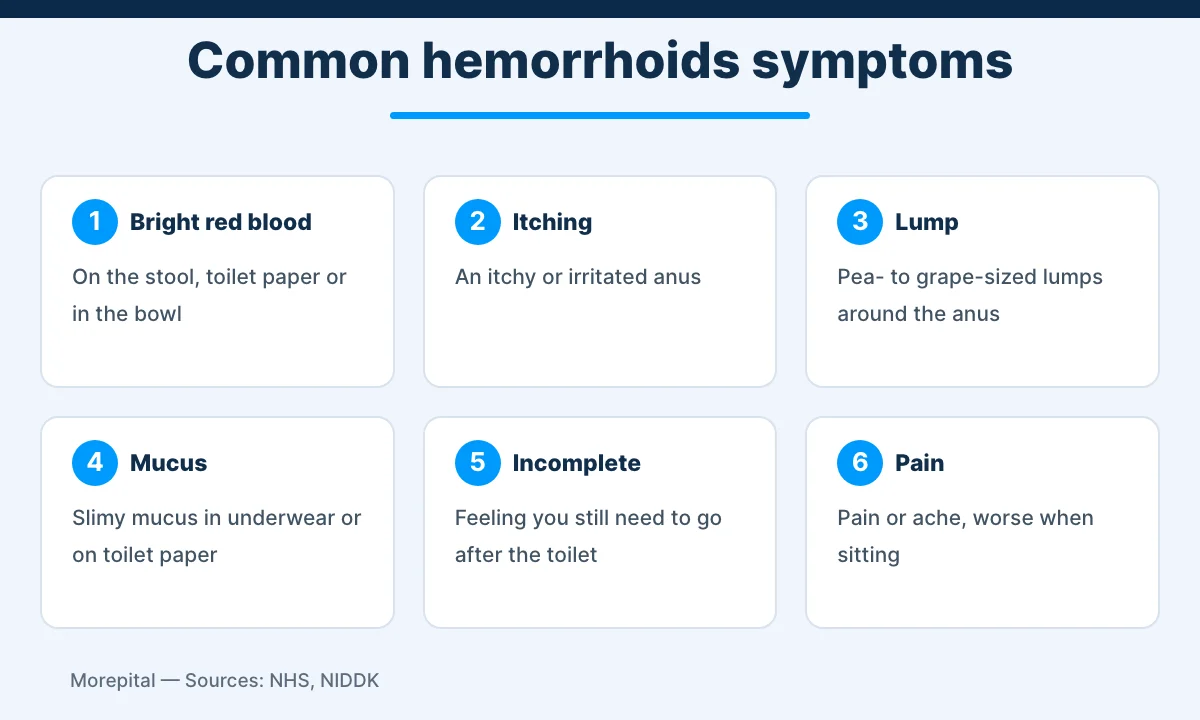
Many hemorrhoids cause no symptoms at all and need no treatment. When symptoms do appear, the NHS lists these as the most typical:
- bright red blood after you poop
- an itchy anus
- a feeling that you still need to go after using the toilet
- slimy mucus in your underwear or on the toilet paper
- lumps around the anus
- pain around the anus
Source: NHS, Merck Manual
Bleeding from internal piles is typically small in amount, bright red and linked to bowel movements; it rarely causes severe blood loss. Over a long time, though, repeated bleeding can lead to iron-deficiency anemia, which shows up as tiredness, pale skin and shortness of breath. If you notice these signs, read our guide to anemia symptoms and ask your doctor for a blood count.
Source: Merck Manual, MedlinePlus, NIDDK
Pain is more typical of external hemorrhoids. A thrombosed external hemorrhoid causes sudden, more severe swelling and pain; according to colorectal surgeons, the pain usually peaks around 48 hours and eases by about day 4, and the clot itself usually disappears over 4 to 6 weeks. Itching is not usually caused by the hemorrhoid itself; it tends to develop when mucus leaks or the area becomes hard to keep clean.
Source: Clinics in Colon and Rectal Surgery (PMC), Merck Manual, Cleveland Clinic
Piles are the most common cause of anal symptoms, but not the only one. An anal fissure (a small tear in the anal skin) can also cause bleeding and sharp pain, and rectal bleeding can be a sign of Crohn’s disease, ulcerative colitis or colorectal cancer.
Causes and risk factors
The exact cause is unclear, but the common thread is extra pressure on the veins of the anus and lower rectum, combined with irregular bowel habits and tissue that weakens with age.
Source: NHS, Cleveland Clinic, NIDDK
Risk factors include:
- Straining during bowel movements and sitting on the toilet for long periods.
- Chronic constipation or chronic diarrhea. Both are common in irritable bowel syndrome, so treating the underlying bowel problem helps.
- A low-fiber diet, which leads to hard, small stools.
- Pregnancy, through pressure from the growing womb and constipation.
- Getting older, especially after 50, as the supporting tissues weaken.
- Frequent heavy lifting.
- Being overweight; obesity raises pressure inside the abdomen.
- Anal intercourse.
Source: NIDDK, Cleveland Clinic, NHS
MedlinePlus also lists childbirth and certain diseases, such as cirrhosis of the liver, as contributors.
Source: MedlinePlus
Rectal bleeding: when to see a doctor
Never simply assume that bleeding comes from piles. The NIDDK advises seeing a doctor if you have any bleeding from the rectum, or if symptoms are still there after one week of home treatment. Doctors look further when bleeding comes with abdominal pain, new or worsening constipation, or carries on despite treatment; our article on colon cancer symptoms explains these warning signs.
Source: NIDDK, American Family Physician (ASCRS guideline)
See a doctor soon (urgent appointment) if
- symptoms get worse or do not improve after home treatment
- piles keep coming back
- you notice an unusual change around your anus
- you have a very high temperature or feel hot, shivery and generally unwell
- bleeding from the bottom is painless and you do not know why
- pus is leaking from the area
Source: NHS
Get emergency help if
Go to the emergency department or call your local emergency number if bleeding will not stop, if you are passing a lot of blood or large clots, or if the pain is severe. Bleeding with dizziness or faintness also needs immediate care. So does severe anal pain with bleeding, especially with abdominal pain, diarrhea or fever. Do not drive yourself.
Source: NHS, MedlinePlus, NIDDK
How piles are diagnosed
Diagnosis rests on your history and an examination rather than scans. Your doctor will ask about your symptoms, bowel habits, laxative or enema use and other conditions, then look at the skin around the anus for lumps, prolapse, clotted external hemorrhoids, skin tags, irritation and fissures.
Source: NIDDK, American Family Physician (ASCRS guideline)
Common tests include:
- Digital rectal exam: a gloved, lubricated finger checks muscle tone, tenderness, blood and any lumps or masses.
- Anoscopy: a short, lighted tube shows the lining of the anus and lower rectum; most people need no anesthesia.
- Rigid proctosigmoidoscopy or flexible sigmoidoscopy: a longer scope views the rectum and lower colon.
These tests are usually done in the clinic and are not painful, though they can feel uncomfortable for a moment.
Source: NIDDK, Cleveland Clinic
A colonoscopy, which examines the whole large bowel, is not needed for everyone. Guidance summarized from the ASCRS recommends considering it when no obvious source of bleeding is found, when there is abdominal pain or new or worsening constipation, or when bleeding continues despite treatment of the hemorrhoids. The Merck Manual likewise notes that rectal bleeding may call for sigmoidoscopy or colonoscopy to rule out a tumor.
Source: American Family Physician (ASCRS guideline), Merck Manual
Treating hemorrhoids at home

Most small hemorrhoids improve with self-care. The first and most important step is to treat constipation and avoid straining. A Cochrane review cited in the ASCRS guidance found that added fiber reduced persistent symptoms by about 53% compared with no added fiber, and fiber also clearly reduced bleeding.
Source: American Family Physician (ASCRS guideline), Cleveland Clinic
Soften your stools
- Eat more fiber from wholegrains, pulses, vegetables, fruit, nuts and seeds. The NHS recommends 30 g a day for adults (most eat about 20 g), and Cleveland Clinic suggests 25 to 38 g a day is enough for most adults.
- If diet is not enough, a fiber supplement such as psyllium or methylcellulose, or a stool softener, can help.
- Drink plenty of water and other non-alcoholic fluids, and cut down on alcohol and caffeine.
Source: NHS (fiber), Cleveland Clinic, NIDDK, NHS
Ease pain, swelling and itching
- Warm sitz baths: sit in a few inches of warm, not hot, water for 10 to 15 minutes (Cleveland Clinic says 10 to 20), several times a day.
- Cold: a towel-wrapped ice pack can reduce pain and swelling.
- Pain relief: the NHS suggests acetaminophen (paracetamol). The NHS advises avoiding ibuprofen if your piles are bleeding and avoiding codeine, which causes constipation.
- Creams, ointments and suppositories: products with hydrocortisone, lidocaine, pramoxine, phenylephrine or witch hazel can relieve itching, pain and swelling.
- Gentle hygiene: clean with moist, fragrance-free wipes or water, pat rather than rub, keep the area dry and wear cotton underwear.
Source: Merck Manual, Cleveland Clinic, NHS, American Family Physician (ASCRS guideline), MedlinePlus
Use medicated creams for short periods only. Doctors usually recommend about one week; see a doctor if symptoms have not improved by then or if you develop dry skin or a rash around the anus. Long-term use of products containing anesthetics, steroids or antiseptics can cause allergic reactions and lasting skin sensitivity.
Source: NIDDK, American Family Physician (ASCRS guideline)
Flavonoid supplements
Oral flavonoid supplements may reduce itching, bleeding, discharge and leakage compared with placebo, according to the ASCRS guidance summary, although how they work is unknown. Ask a pharmacist before trying them.
Source: American Family Physician (ASCRS guideline)
Office procedures and surgery for hemorrhoids
If home care fails, office-based procedures are preferred over surgery because they give similar benefit with fewer complications. You stay awake, sometimes with the area numbed, and go home the same day. No treatment guarantees that hemorrhoids will not return.
Source: American Family Physician (ASCRS guideline), NHS
Rubber band ligation (banding)
Banding is the standard treatment for persistent internal hemorrhoids. A small elastic band, about ¼ inch (roughly 6 mm) wide, is placed at the base of the hemorrhoid above the dentate line, cutting off its blood supply. The hemorrhoid withers and falls off, usually within a week. Often one hemorrhoid is treated per session about every two weeks, so several visits may be needed.
Source: Merck Manual, NIDDK, American Family Physician (ASCRS guideline)
In a review of the evidence by colorectal surgeons, banding succeeded in about 80% of patients, though recurrence can occur and roughly 10% eventually needed surgery. In one study of 512 patients, 2.5% had complications needing hospital care. Bleeding is the most common problem. Perineal sepsis, a serious infection, is rare, so report fever, worsening pain or trouble passing urine after banding straight away.
Source: Clinics in Colon and Rectal Surgery (PMC)
Other office procedures
- Sclerotherapy: an injected solution creates scar tissue that shrinks the hemorrhoid; often used for bleeding internal hemorrhoids.
- Infrared coagulation: infrared light produces heat that scars and shrinks the tissue.
- Electrocoagulation: a gentle electric current has the same aim. The Merck Manual notes that laser, freezing and electrocoagulation treatments are less well proven.
Source: NIDDK, NHS, Merck Manual
Surgery
Surgery is used for large hemorrhoids, grade IV prolapse or symptoms that do not respond to other treatment. You are usually asleep, and you may go home the same day or the next day. The main options are:
- Hemorrhoidectomy: the piles are cut out. It works well for large piles but may cause severe pain afterward.
- Stapled hemorrhoidopexy: a stapling device removes internal tissue and lifts prolapsed tissue back into place.
- Hemorrhoidal artery ligation (dearterialization): stitches tie off the feeding arteries, sometimes guided by Doppler ultrasound.
Source: NHS, NIDDK, Cleveland Clinic, Merck Manual
After a hemorrhoidectomy, pain can delay a full return to normal activities for 3 to 4 weeks, and some people have temporary difficulty passing urine or constipation. Stapled surgery causes less pain than conventional surgery, but a meta-analysis found more recurrences at six months.
Source: Clinics in Colon and Rectal Surgery (PMC), Merck Manual
Thrombosed external hemorrhoids
A painful clotted external hemorrhoid can be treated with pain relief, sitz baths and cool compresses. If the pain is severe and you are seen early, a doctor can numb the area and remove the clot. Colorectal surgeons report the best results from excision within the first 48 to 72 hours; if you are already getting better, conservative care is usually advised because the procedure itself may hurt more than the resolving clot.
Source: Clinics in Colon and Rectal Surgery (PMC), Merck Manual
Prevention, including in pregnancy
The habits that relieve hemorrhoids also help prevent them:
- Go when you feel the urge, rather than holding it in.
- Do not strain, and do not sit on the toilet longer than needed.
- Eat high-fiber foods every day and drink enough fluid.
- Stay active, which also helps prevent constipation.
- Avoid regular heavy lifting where you can.
- Use laxatives or enemas only as your doctor advises.
Source: Cleveland Clinic, NIDDK, NHS
Hemorrhoids in pregnancy
Piles are common in pregnancy, and constipation is a frequent trigger. The NHS suggests eating plenty of fiber, such as wholemeal bread, fruit and vegetables, drinking plenty of water, exercising regularly, not standing or sitting for long periods, avoiding straining, using moist toilet paper and holding a cloth soaked in iced water gently against the area for pain. Check with your doctor, midwife or pharmacist before using any cream or medicine; hydrocortisone and pramoxine products are described as safe and effective in late pregnancy in the ASCRS guidance summary.
Source: NHS (pregnancy), American Family Physician (ASCRS guideline)
Keep in mind that medicines for piles in pregnancy treat the symptoms rather than the cause: they soothe inflammation, while fiber, fluids and activity tackle the constipation behind it. Mention any bleeding in pregnancy or after birth to your midwife or doctor so that other causes can be ruled out.
Source: NHS (pregnancy), MedlinePlus
Hemorrhoids: frequently asked questions
Do hemorrhoids go away on their own?
Often, yes. Small piles frequently settle within a few days. If symptoms last longer than a week despite home care, see a doctor.
Are hemorrhoids dangerous?
Usually not. Possible complications include clots, skin tags, infection, a strangulated internal hemorrhoid (when blood flow to a prolapsed hemorrhoid is cut off) and anemia from long-term bleeding. Heavy bleeding or severe pain needs urgent care.
Source: NIDDK, Cleveland Clinic
Can hemorrhoids turn into cancer?
The sources reviewed here do not describe piles turning into cancer. The real concern is that colorectal cancer and inflammatory bowel disease can cause the same bleeding, so new bleeding should be examined rather than assumed to be piles.
Source: NIDDK, Merck Manual
How long do thrombosed hemorrhoids last?
Pain usually peaks at about 48 hours and settles by around day 4, while the clot itself typically disappears over 4 to 6 weeks. Early removal within 48 to 72 hours may help if pain is severe.
Source: Clinics in Colon and Rectal Surgery (PMC), Merck Manual
Does rubber band ligation hurt?
Banding is done above the dentate line, where there are few pain fibers, so it is usually well tolerated. Minor pain is reported in about 2% of patients in one large series, and you normally go home the same day.
Source: Clinics in Colon and Rectal Surgery (PMC), NHS
Disclaimer: this article is for general health education and does not replace advice from a qualified doctor who can assess your individual case. Last updated: October 2026.