
Hollywood smile
Smile makeover (veneers, crowns, whitening, bonding)
Hollywood smile is a popular marketing term for a cosmetic smile makeover that gives very white, even front teeth, most often with porcelain or composite veneers. Depending on the case it can also mean dental crowns, teeth whitening or composite bonding, which differ greatly in how much natural tooth they remove. None of these results is permanent, and veneers and crowns cannot usually be undone.
Source: J Pharm Bioallied Sci (PMC), Cureus (PMC), Cleveland Clinic, Cleveland Clinic
- What is a Hollywood smile?
- Who is a candidate and who is not
- Preparing for a smile makeover
- How each procedure is done
- Veneers vs crowns: why the difference matters
- Recovery timeline
- Results and how long they last
- Risks and complications
- Alternatives to a full Hollywood smile
- Choosing a dentist and treatment abroad
- When to call your dentist
- FAQ
- Sources
What is a Hollywood smile?
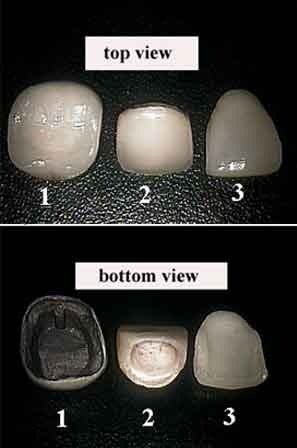
A Hollywood smile is a popular, non-medical name for a cosmetic smile makeover that leaves the front teeth looking very white, even and uniform, like the smiles seen on film stars and on social media. It is not a single procedure and it has no clinical definition. In practice the term is most often used for a set of porcelain or composite veneers on the front teeth, and a recent review describes it as the uniform, bright result built from porcelain or resin veneers.
Source: J Pharm Bioallied Sci (PMC), Cureus (PMC)
Depending on the clinic and on the state of your teeth, the same label can also cover dental crowns, professional teeth whitening, composite bonding and gum contouring, alone or in combination. Because the words mean different things to different providers, the most important step is to find out exactly which procedure, on how many teeth, is being proposed, and how much natural tooth it will remove.
Source: Cleveland Clinic, ADA MouthHealthy, Oral Health Foundation
Demand has grown with social media. In a 2022 survey of 2,061 adults in five Gulf countries, 97% knew the term “Hollywood smile” and about two in three had learned about it on social media, yet fewer than 5% had actually had veneers. Among those treated, 82% were satisfied, but 42% reported some problem, most often with the shape, size or color of the teeth.
Source: J Pharm Bioallied Sci (PMC)
The four procedures behind the name
| Procedure | What it does | Tooth removed | Typical lifespan |
|---|---|---|---|
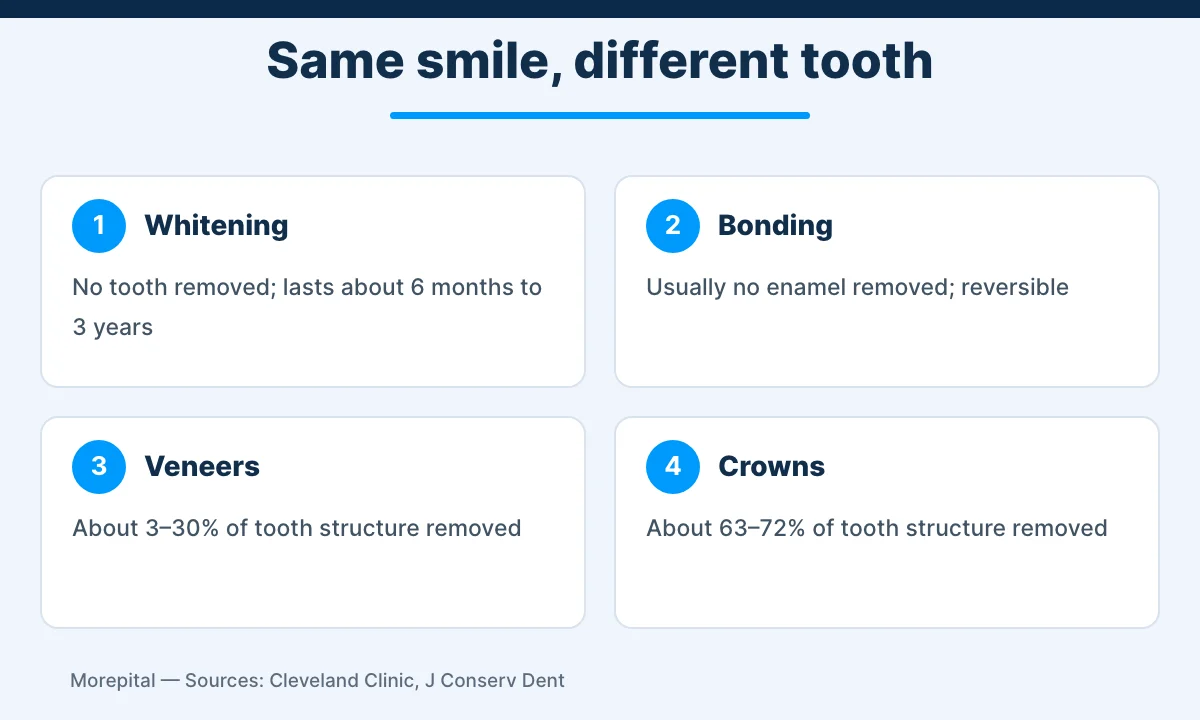
| Teeth whitening | Bleaches natural enamel a lighter shade | None | About 6 months to 3 years |
| Composite bonding | Resin sculpted onto teeth to fix chips, gaps or stains | Usually none | About 3 to 10 years before touch-ups |
| Porcelain veneers | Thin shells bonded to the front surface | A small amount of enamel (front and sides) | About 10 to 15 years |
| Dental crowns | Caps that cover the whole tooth | Tooth reshaped on all sides | About 5 to 15 years, sometimes longer |
Source: Cleveland Clinic, Cleveland Clinic, Cleveland Clinic, Cleveland Clinic
Who is a candidate and who is not
Anyone who wants a Hollywood smile because they are unhappy with the color, shape, small chips or gaps of their front teeth can talk to a dentist about cosmetic options. Veneers in particular require teeth that are free of extensive cavities and gum disease; decay and gum problems should be treated first, because covering unhealthy teeth can make them worse.
Source: Cleveland Clinic, ADA MouthHealthy
The right procedure depends on what you want to change:
Source: Cleveland Clinic, Cleveland Clinic
- Color only: whitening is usually the first step for discoloration, and it works best on surface (extrinsic) stains.
- Deep stains on a few teeth: bonding can hide discoloration that does not improve with whitening.
- Widespread stains, chips or uneven shape: veneers can mask discoloration across many teeth that whitening cannot fix.
- Weakened, broken or heavily decayed teeth: crowns are meant for teeth that need protection and strength, not only a new color.
Source: Cleveland Clinic, Cleveland Clinic
Some people should be cautious. Veneers may not be a good choice if you clench or grind your teeth or have a deep overbite, and long-term studies link tooth grinding (bruxism) with higher veneer failure rates. Whitening is not done for anyone aged 17 or under, for people with unhealthy teeth or gums, or during pregnancy or breastfeeding, according to the NHS.
Source: ADA MouthHealthy, Eur J Dent (PMC), NHS
Preparing for a smile makeover
A safe Hollywood smile plan starts with a full examination by a qualified dentist, including your medical history, medicines, past dental work and habits such as smoking. Gum disease and cavities are treated before any cosmetic work. Ask for a written treatment plan that lists each tooth, the procedure for each, and a full cost breakdown.
Source: General Dental Council, Oral Health Foundation, Cleveland Clinic
Many dentists now use digital planning, such as Digital Smile Design, so you can preview the proposed shape and color before any irreversible step. A review of social media and esthetic dentistry recommends this kind of preview and warns that edited before-and-after photos can create unrealistic expectations.
Source: Cureus (PMC)
Because whitening does not change the color of existing crowns, veneers or fillings, dentists usually whiten natural teeth first, if you want it, so new restorations can be matched to the lighter shade.
Source: ADA MouthHealthy, NHS
How each procedure is done
Teeth whitening
Whitening is the least invasive part of a Hollywood smile. In-office whitening is usually done in a single visit: the dentist protects your gums and applies a bleaching gel, sometimes with a light or laser, in a session of about one to two hours. Dentist-supervised home whitening uses custom trays and gel worn for about two to six weeks. Over-the-counter kits contain less bleach and are less effective.
Source: NHS, ADA MouthHealthy, NHS
Composite bonding
The dentist applies a putty-like, tooth-colored resin, shapes it, hardens it with a curing light and polishes it. It usually takes 30 to 60 minutes per tooth, is often finished in one visit and typically needs no enamel removal.
Source: Cleveland Clinic
Porcelain veneers
- First visit: the dentist checks that you are suitable, removes a small amount of enamel from the front and sides of each tooth, and takes an impression or 3D scan.
- A lab makes the veneers over a few weeks; temporary veneers may be worn in the meantime.
- Second visit: the dentist checks shape, color and fit, bonds each veneer with dental cement and adjusts the bite.
Source: Cleveland Clinic, ADA MouthHealthy
Dental crowns
- First visit: the tooth is reshaped all around so the crown fits over it, impressions are taken, and a temporary crown is placed.
- A lab makes the crown, usually in two to three weeks (same-day milled ceramic crowns are possible in some offices).
- Second visit: the temporary is removed and the permanent crown is checked and cemented.
Source: Cleveland Clinic, NHS
Veneers vs crowns: why the difference matters
A Hollywood smile made with veneers and one made with crowns can look similar in a photo, but they are very different for the tooth underneath. A veneer covers only the front surface and is cosmetic; it does not strengthen the tooth. A crown covers the whole tooth and is mainly meant to restore a tooth that is badly damaged, weak or root-canal treated.
Source: Cleveland Clinic, Cleveland Clinic
The amount of tooth removed is the key difference. A widely cited laboratory study (Edelhoff and Sorensen, 2002), summarized in a 2011 review, found that veneer preparations removed roughly 3% to 30% of the visible tooth structure by weight, while all-ceramic and metal-ceramic crown preparations removed about 63% to 72%. A metal-ceramic crown required about 4.3 times more tooth removal than a front-surface veneer.
Source: J Conserv Dent (PMC)
Removing more tooth is not without consequences. In a prospective study of 120 teeth with healthy pulps that were prepared for crowns, 9% developed silent pulp (nerve) death and needed root canal treatment; the rate was 5% for previously intact teeth and 13% for teeth that already had decay or fillings. The Oral Health Foundation also warns that aggressive tooth reduction can damage the nerve and lead to costly repairs.
Source: Int Endod J (PubMed), Oral Health Foundation
For these reasons, for a Hollywood smile on healthy teeth that only need a color or minor shape change, whitening, bonding or veneers are generally better suited than full crowns. If a plan proposes crowns on many healthy front teeth, ask why, and consider a second opinion.
Source: Cleveland Clinic, NHS, Oral Health Foundation
Recovery timeline
The procedures used for a Hollywood smile need little or no downtime. Most people return to work and normal activities the same day.
Source: Cleveland Clinic, Cleveland Clinic, Cleveland Clinic
| Time | What to expect |
|---|---|
| Same day | Eat and drink once any numbness wears off; normal activities resume after veneers or bonding. |
| First days | Sensitivity to cold or sweet food and sore gums are common after whitening and usually short-lived. |
| First few weeks | Heat and cold sensitivity is common after crowns, especially early on; report a bite that feels wrong. |
| Long term | Regular checkups; cavities can still form under or around veneers and crowns. |
Source: Cleveland Clinic, NHS, Cleveland Clinic, ADA MouthHealthy
Results and how long they last
No Hollywood smile is permanent. Cleveland Clinic gives approximate lifespans of six months to three years for whitening, about five to eight years for bonding (other Cleveland Clinic guidance says three to 10 years before touch-ups), and five to 15 years for veneers. Crowns last on average five to 15 years and sometimes much longer with good care. The NHS says whitening may last around three years if you follow your dentist’s advice.
Source: Cleveland Clinic, Cleveland Clinic, Cleveland Clinic, Cleveland Clinic, NHS
Clinical studies of porcelain veneers report widely varying survival. A 2021 systematic review of 30 studies (over 11,000 veneers) found 10-year survival figures ranging from about 53% to 96% between studies, with ceramic fracture the most common reason for failure. The authors note that reliable data beyond 20 years are lacking.
Source: Eur J Dent (PMC)
A Hollywood smile is therefore a long-term commitment: veneers and crowns will need repair or replacement over a lifetime, and since enamel removal cannot be undone, the tooth will always need some covering afterward.
Source: Cleveland Clinic, ADA MouthHealthy
To protect the result, brush twice a day with fluoride toothpaste, clean between your teeth daily, avoid biting nails, ice or hard objects, wear a mouthguard for contact sports, and ask about a night guard if you grind your teeth.
Source: ADA MouthHealthy, Cleveland Clinic
Risks and complications
- Irreversibility: porcelain veneers and crowns need enamel removal, so the change usually cannot be undone.
- Sensitivity: sensitivity to heat and cold after veneers and crowns; after whitening, peroxide can irritate the nerve temporarily.
- Chipping and debonding: veneers and bonding can chip, crack, wear or come loose; crowns can break.
- Decay and gum problems: a poorly fitting crown can trap bacteria and lead to decay; decay can form under veneers.
- Nerve damage: heavy tooth preparation can lead to pulp death and root canal treatment.
- Gum irritation: whitening gel can cause sore gums, a sore throat or white patches on the gums.
- Unhappy result: in the Gulf survey, dissatisfaction mostly concerned shape, size and color.
Source: Cleveland Clinic, Cleveland Clinic, ADA MouthHealthy, NHS, Int Endod J (PubMed), J Pharm Bioallied Sci (PMC)
Choosing an unlicensed provider for a Hollywood smile adds extra risk. The American Dental Association warns about unlicensed “veneer technicians” on social media, whose work can cause infection and nerve damage and may be placed over unhealthy teeth. In the UK, whitening by a beauty salon without a dental professional is illegal, and the NHS advises checking a provider on the General Dental Council register.
Source: ADA MouthHealthy, NHS
Alternatives to a full Hollywood smile
A full Hollywood smile with a set of veneers or crowns is not the only way to improve a smile. Less invasive options include:
Source: ADA MouthHealthy, Cleveland Clinic
- Professional whitening for natural teeth that are yellow or stained.
- Composite bonding or composite veneers for small chips, gaps or isolated stains; they are easier to repair, though less stain-resistant than porcelain.
- Minimal-prep or no-prep veneers, which remove less enamel; they are not right for everyone.
- Tooth contouring (enameloplasty) to reshape small irregularities, and gum contouring for an uneven gum line.
- Orthodontics, including clear aligners, for crooked or crowded teeth.
Source: ADA MouthHealthy, Cleveland Clinic, Cleveland Clinic, ADA MouthHealthy
Yellow teeth usually respond well to whitening, brown teeth less well, and gray teeth may not whiten at all; stains from medicines or injury may need bonding or veneers instead.
Source: ADA MouthHealthy
Choosing a dentist and treatment abroad
Many people travel for a Hollywood smile because of lower prices. UK dental bodies do not forbid this but urge careful checks. The Oral Health Foundation lists poorly fitting or broken crowns, veneers and bridges, infection, ongoing pain and treatment more extensive than expected among the reported problems, and notes that countries differ in how much natural tooth is removed; it warns that aggressive tooth reduction can damage the nerve. A 2026 survey of 326 dentists in Saudi Arabia found veneers (82%) and crowns (79%) were the most common treatments received abroad, and the most frequent problems were lack of treatment planning, no practitioner available afterward and no follow-up maintenance.
Source: Oral Health Foundation, Oral Health Foundation, BMC Oral Health (PMC)
Before you commit, the NHS, the General Dental Council and the Oral Health Foundation advise you to:
Source: NHS, General Dental Council, Oral Health Foundation
- Talk to your own dentist first, or get an independent local opinion, about whether the treatment is needed.
- Check that the dentist is qualified and registered with the regulator in that country.
- Get a full assessment, a written treatment plan for each tooth and a full cost breakdown before agreeing.
- Ask whether veneers or crowns are planned, how much tooth will be removed, and how long the work should last.
- Ask about guarantees, aftercare, complaints procedures and who pays for corrective work.
- Be wary of hard selling, pressure to decide quickly, and no discussion of complications or aftercare.
- Plan enough time for fitting and adjustments, and check that your travel insurance covers the trip.
Source: NHS, General Dental Council, Oral Health Foundation, Oral Health Foundation
Bite adjustments often take repeat visits, which is harder when the dentist is abroad, and fixing problems later can cost more than the original treatment. For country-specific information, see our guide to veneers in Turkey.
Source: Oral Health Foundation, Oral Health Foundation
When to call your dentist
Contact your dentist promptly if you notice any of the following after a Hollywood smile treatment:
Source: Cleveland Clinic, ADA MouthHealthy, Cleveland Clinic
- A crown or veneer feels loose, chips, cracks or falls off.
- Your bite feels wrong or a bonded tooth has a sharp edge.
- Sensitivity or gum soreness lasts or keeps getting worse.
- You notice a bad taste or bad breath around a restoration.
- You have pain, swelling or signs of infection around a treated tooth.
Source: Cleveland Clinic, ADA MouthHealthy, Cleveland Clinic, NHS, Oral Health Foundation
Further reading
Hollywood smile: frequently asked questions
What procedures make a Hollywood smile?
A Hollywood smile most often means porcelain or composite veneers on the front teeth. Depending on the case it may also include whitening, bonding, crowns or gum contouring.
Source: J Pharm Bioallied Sci (PMC), Cureus (PMC), Cleveland Clinic
Is a Hollywood smile the same as veneers?
Not always. Many people use the term for veneers, but some clinics use it for full crowns, which remove much more tooth. Ask which one is planned.
Source: J Pharm Bioallied Sci (PMC), J Conserv Dent (PMC), Oral Health Foundation
Is a Hollywood smile permanent?
No. Veneers last about 10 to 15 years and crowns about 5 to 15 years before repair or replacement, and the enamel removed does not grow back.
Source: Cleveland Clinic, Cleveland Clinic
Does getting a Hollywood smile hurt?
Your dentist numbs the teeth for veneer and crown preparation and can give more anesthetic if you feel pain; you can eat once it wears off. Temporary sensitivity to heat and cold is common afterward.
Source: Cleveland Clinic, Cleveland Clinic
Can veneers or crowns be whitened later?
No. Whitening only lightens natural teeth, not crowns, veneers or fillings, so whiten first if you want a lighter shade.
Source: ADA MouthHealthy, NHS
Are crowns or veneers better for a Hollywood smile?
For healthy teeth that only need a color or shape change, veneers are far less invasive. Crowns are meant for weak, broken or heavily filled teeth.
Source: Cleveland Clinic, Cleveland Clinic, J Conserv Dent (PMC)
Is it safe to get a Hollywood smile abroad?
It can be, but UK dental bodies warn about poorly fitting crowns and veneers, more tooth removal than expected and hard-to-reach aftercare. Check registration, plan and aftercare first.
Can I get a Hollywood smile with gum disease or cavities?
Decay and gum disease must be treated first. Placing veneers over unhealthy teeth can make problems worse.
Source: Cleveland Clinic, ADA MouthHealthy
How long does a Hollywood smile take?
Whitening or bonding can be finished in one visit. Veneers and crowns usually need two visits a few weeks apart while a lab makes them.
Source: NHS, Cleveland Clinic, Cleveland Clinic, Cleveland Clinic
Considering a Hollywood smile? Contact us for a free consultation and a clear, tooth-by-tooth treatment plan.
Sources
- Cleveland Clinic — Veneers: What Are Dental Veneers?
- Cleveland Clinic — Dental Crowns
- Cleveland Clinic — Cosmetic Dentistry
- Cleveland Clinic — Dental Bonding
- Cleveland Clinic — Tooth Discoloration
- ADA MouthHealthy — Veneers
- ADA MouthHealthy — Teeth Whitening
- ADA MouthHealthy — 8 Ways to Improve Your Smile
- NHS — Teeth whitening
- NHS — Dental treatments
- NHS — Treatment abroad checklist
- General Dental Council — Going abroad for dental treatment
- Oral Health Foundation — Going abroad for dental treatment: risks
- Oral Health Foundation — I am thinking about getting treatment overseas. Is this a good idea?
- J Pharm Bioallied Sci (PMC) — Reasons for widespread aspiration of esthetic veneers "Hollywood smile": a survey among five Gulf countries
- Cureus (PMC) — Influence of social media on the demand for esthetic dental treatment
- J Conserv Dent (PMC) — Survival rates of porcelain laminate restoration based on different incisal preparation designs
- Eur J Dent (PMC) — Survival rates for porcelain laminate veneers: a systematic review
- Int Endod J (PubMed) — A prospective study of the incidence of asymptomatic pulp necrosis following crown preparation
- BMC Oral Health (PMC) — Investigating dentists' perspectives of dental tourism trends in the Eastern Province, Saudi Arabia
This page is part of the Morepital medical reference. It is for general health education and does not replace a consultation with a qualified doctor. Last reviewed: October 2026.