
Dental implants
Endosseous dental implants (implant-supported teeth)
Dental implants are small titanium or ceramic posts placed in the jawbone to replace the roots of missing teeth and support crowns, bridges or dentures. After the bone fuses to the implant over several months, the new teeth work much like natural ones, and studies estimate that about 93–96% of implants still function after 10 years.
Source: Cleveland Clinic, NHS, Journal of Dentistry (Howe et al., 2019)
- What are dental implants?
- Who is a candidate for dental implants?
- Preparing for dental implant treatment
- How dental implant surgery is done
- Recovery timeline after dental implants
- Results and how long dental implants last
- Risks and complications of dental implants
- Caring for dental implants long term
- Alternatives to dental implants
- Choosing a dentist and getting dental implants abroad
- When to call your dentist
- FAQ
- Sources
What are dental implants?
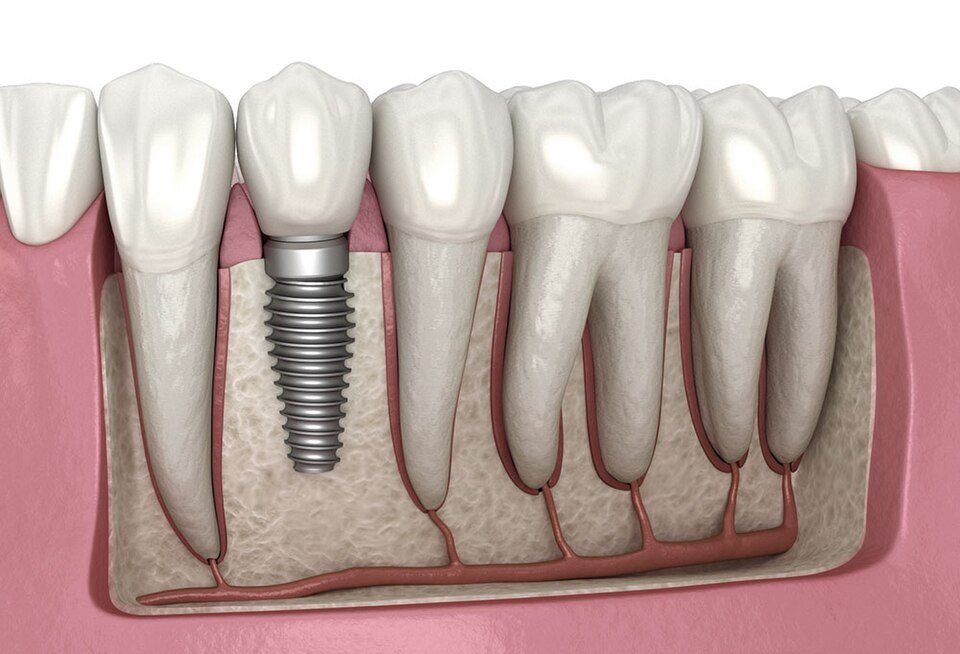
Dental implants are small, screw-shaped posts that a dental surgeon places into the jawbone to take the place of the roots of missing teeth. Once the bone has grown firmly around them, they act as anchors for replacement teeth: a single crown, a bridge spanning several gaps, or a full denture. Most implants are made of titanium, although some are ceramic, and both materials are considered biocompatible, meaning the body tolerates them well.
Source: Cleveland Clinic, NHS
An implant restoration has three parts. The implant (fixture) is the threaded post that sits in the bone like an artificial root. The abutment is a small connector that screws into the implant and rises just above the gum line. The restoration is the visible tooth or teeth, such as a crown, bridge or implant-supported denture. In everyday speech, people often use the word “implant” to mean the whole unit, root and tooth together.
Source: Cleveland Clinic, American Academy of Periodontology
Why bone bonding matters
The success of dental implants depends on osseointegration, the process in which living jawbone grows onto the implant surface and locks it in place. This bonding takes months, which is why implant treatment is usually done in stages rather than in a single visit. Because the implant sits in the bone, it also helps preserve the jawbone, which tends to shrink where a tooth has been lost, and it does not require grinding down healthy neighboring teeth, as a conventional bridge does.
Source: Cleveland Clinic, Cambridge University Hospitals NHS
Types of dental implants
The American Academy of Periodontology describes two main designs. Endosteal implants, placed inside the bone as screws, cylinders or blades, are by far the most common. Subperiosteal implants sit on top of the jawbone under the gum, with a metal framework whose posts protrude through the gum; they are generally reserved for people who cannot wear conventional dentures and lack the bone height for an endosteal implant.
Source: American Academy of Periodontology
Implants are also grouped by how many teeth they replace:
- Single-tooth implant: one implant carrying one crown.
- Implant-supported bridge: two or more implants holding a fixed bridge that replaces three or more teeth.
- Full-arch restoration: usually four to six implants supporting a whole upper or lower set of teeth, either fixed in place or as a snap-on denture. The All-on-4 technique is one well-known full-arch approach.
Source: Cleveland Clinic, American Academy of Periodontology
Who is a candidate for dental implants?
Implants may suit people who have lost one or more teeth to gum disease (periodontitis), decay, injury or other causes and who would rather not rely on removable dentures. The ideal candidate is in good general and oral health, has healthy gums free of periodontal disease, and has enough jawbone to hold the implant. Where bone is lacking, it can often be rebuilt with grafting before or during implant placement.
Source: American Academy of Periodontology, Cleveland Clinic
Age matters mainly because the jaw must have stopped growing. Cleveland Clinic gives a typical minimum age of 18 with no upper age limit, and NHS hospital services similarly place implants only once growth is complete. Suitability also depends on your willingness to attend several appointments over a number of months and to commit to long-term care: daily brushing and flossing, regular dental check-ups and not smoking.
Source: Cleveland Clinic, Leeds Teaching Hospitals NHS
Who may not be a good candidate
Some conditions increase the chance that an implant will fail or develop complications. Your dentist may recommend delaying or avoiding implants, or treating the underlying problem first, if you have:
- Active or untreated gum disease, or widespread tooth decay
- Poor oral hygiene
- Severe loss of jawbone
- Poorly controlled diabetes
- Certain bone disorders or autoimmune conditions
- A history of radiotherapy to the jaws
- Treatment with certain medicines, such as bisphosphonates
- A smoking or vaping habit, which can disrupt healing
Source: Cleveland Clinic, Leeds Teaching Hospitals NHS
Having one of these conditions does not always rule out treatment. Cleveland Clinic notes that some people with autoimmune diseases have success rates comparable to people without them, although certain conditions and medicines raise the risk of complications.
Source: Cleveland Clinic
Preparing for dental implant treatment
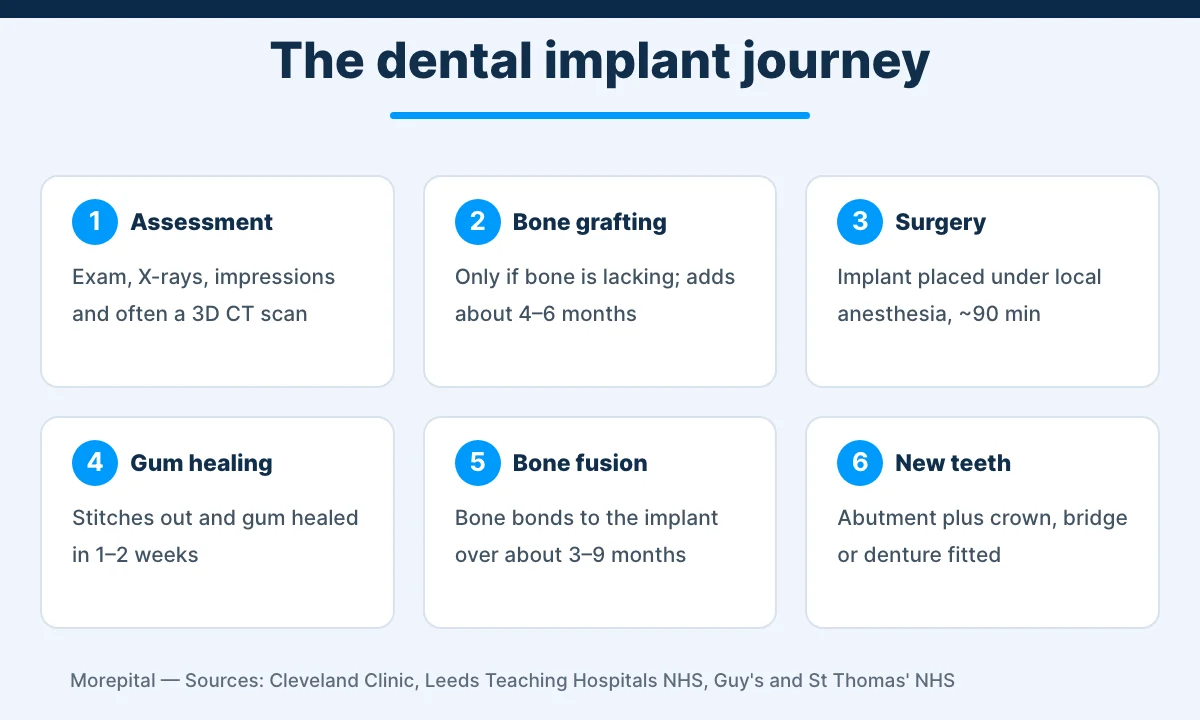
Treatment starts with a detailed assessment. The dental team examines your mouth, takes X-rays and impressions (molds) of your teeth, and often arranges a 3D cone beam CT scan to measure the height, width and quality of the jawbone and to locate nerves and sinuses. These records are used to plan the exact position of each implant and the design of the final teeth.
Source: Leeds Teaching Hospitals NHS, Cambridge University Hospitals NHS, Guy’s and St Thomas’ NHS
Before implants are placed, any decay or gum infection usually needs to be treated, since a healthy mouth is a precondition for success. If a failing tooth has to be removed, the implant may be placed weeks later once the gum has healed (early placement, often 6 to 10 weeks after extraction) or, in suitable cases, at the same visit as the extraction (immediate placement). A removable temporary denture can fill the gap in the meantime.
Source: Leeds Teaching Hospitals NHS, Cambridge University Hospitals NHS
Bone grafting and sinus lifts
If there is not enough bone, it can be built up with your own bone or a bone substitute. Small defects can be grafted at the same time as the implant, while larger ones need grafting months beforehand; very large defects may need a block of bone taken from the chin or hip under general anesthesia. In the upper back jaw, where the sinus sits close to the roots, a sinus augmentation (sinus lift) raises the sinus floor to create room for bone. Grafting adds time to treatment: Guy’s and St Thomas’ estimates 4 to 6 extra months, and Cambridge University Hospitals at least four months.
Source: Leeds Teaching Hospitals NHS, American Academy of Periodontology, Guy’s and St Thomas’ NHS, Cambridge University Hospitals NHS
Stop smoking
Smoking is one of the strongest risk factors for implant failure. Cambridge University Hospitals expects patients to stop at least six months before starting treatment, and Guy’s and St Thomas’ advises stopping before treatment and staying smoke-free long term.
Source: Cambridge University Hospitals NHS, Guy’s and St Thomas’ NHS
How dental implant surgery is done
Implant placement is usually carried out under local anesthesia, which numbs the area so you should not feel pain during the procedure. Sedation can be added if you are anxious, and some hospital services offer general anesthesia in selected cases. At Leeds Teaching Hospitals, a typical implant operation takes around 90 minutes and patients go home the same day.
Source: Guy’s and St Thomas’ NHS, Cleveland Clinic, Guy’s and St Thomas’ NHS, Leeds Teaching Hospitals NHS
The surgical steps are broadly similar across clinics:
- Numbing: local anesthetic is injected into the gum, with optional sedation.
- Opening the gum: the surgeon makes a cut and lifts the gum away to expose the bone.
- Preparing the site: a small hole is drilled in the jawbone and gradually widened to fit the implant.
- Placing the implant: the implant is screwed into the prepared site; minor bone grafting may be done at this stage.
- Closing: the gum is repositioned and held with stitches, which are usually removed about a week later.
Source: Cleveland Clinic, Guy’s and St Thomas’ NHS
One-stage and two-stage techniques
In a one-stage approach, a healing cap is fitted right away and remains visible through the gum. In a two-stage approach, the implant is buried under the gum while it heals and later exposed in a minor second procedure under local anesthesia so the abutment can be attached. Your surgeon chooses the approach after examining your mouth.
Source: Cambridge University Hospitals NHS, Leeds Teaching Hospitals NHS
Fitting the new teeth
Once the implant has bonded to the bone, impressions are taken and the final crown, bridge or denture is made, often with temporary teeth first and several appointments a few weeks apart. Attaching the abutment and restoration itself usually takes about an hour. For implants in visible front areas, a temporary tooth can often be provided during healing.
Source: Leeds Teaching Hospitals NHS, Cleveland Clinic
Recovery timeline after dental implants
Most people have some soreness, swelling, bruising and minor bleeding for a few days. These usually respond to regular over-the-counter painkillers such as paracetamol (acetaminophen) or ibuprofen and settle within about a week. Swelling and bruising tend to be worst 24 to 48 hours after surgery. Guy’s and St Thomas’ advises that most people can return to work the day after treatment.
Source: Guy’s and St Thomas’ NHS, Leeds Teaching Hospitals NHS, Cleveland Clinic
| Time after surgery | What to expect |
|---|---|
| First 6 hours | Cold pack wrapped in cloth for 10 minutes each hour to limit swelling; firm pressure on a rolled gauze or handkerchief for at least 30 minutes if the site bleeds. |
| First 24–48 hours | Peak swelling and bruising; take pain relief regularly; avoid alcohol for 24 hours; soft foods if advised. |
| First week | Do not brush the implant site; discomfort fades; many people feel back to normal within about a week. |
| 1–2 weeks | Gum heals; stitches removed and wound checked at a review 7 to 14 days after surgery; antimicrobial (chlorhexidine) mouthwash as directed. |
| Up to 2 weeks | Some denture wearers cannot wear their denture over the healing site; it may need adjusting or relining later. |
| About 2–9 months | Bone bonds to the implant (osseointegration); estimates range from 2–6 months (Leeds), 3–6 months (Cambridge) and 3–9 months (Cleveland Clinic). |
| After bonding | Abutment and final crown, bridge or denture fitted over several visits. |
Source: Guy’s and St Thomas’ NHS, Leeds Teaching Hospitals NHS, Cambridge University Hospitals NHS, Cleveland Clinic
Overall, sources differ on total treatment time because cases differ. Guy’s and St Thomas’ says the full course could take 6 to 12 months, while Cambridge University Hospitals says treatment usually takes at least one year from start to finish, longer if bone grafting is needed.
Source: Guy’s and St Thomas’ NHS, Cambridge University Hospitals NHS, Leeds Teaching Hospitals NHS
Results and how long dental implants last
Dental implants have a high long-term survival rate. A 2019 systematic review in the Journal of Dentistry pooled 18 studies and estimated 10-year survival at the implant level at 96.4%; a more cautious sensitivity analysis that accounted for patients lost to follow-up gave 93.2%. NHS hospital figures are in the same range: Leeds Teaching Hospitals reports that about 90% of implants placed 10 years ago are still present and working, and Cambridge University Hospitals quotes 80% to 95% over 15 years in people with healthy mouths.
Source: Journal of Dentistry (Howe et al., 2019), Leeds Teaching Hospitals NHS, Cambridge University Hospitals NHS
Results are less predictable in people with a history of gum disease: Cambridge University Hospitals gives a success rate of 80% to 85% over seven years for these patients. Bone quality, gum health and, above all, smoking strongly influence the outcome.
Source: Cambridge University Hospitals NHS
The implant itself can last a lifetime with good care, but the teeth attached to it wear over time. Cleveland Clinic estimates that implant crowns and bridges last around 15 years and implant-supported dentures at least seven years before they need replacing. Porcelain can chip, crowns can loosen, and the clips that hold an overdenture wear and need renewing. Once healed, implant teeth restore chewing and speech, improve the look of the smile, stabilize loose dentures and help prevent the sunken facial look that follows bone loss.
Source: Cleveland Clinic, Leeds Teaching Hospitals NHS, Cambridge University Hospitals NHS
Risks and complications of dental implants
Dental implants are generally safe when placed by an experienced team, but like any surgery they carry risks. During or soon after surgery these include bleeding (severe bleeding is extremely rare), infection, and numbness of the lip, chin or gum from nerve irritation, which usually improves over time; permanent numbness is very rare. Occasionally an implant cannot be placed as planned.
Source: Cleveland Clinic, Cambridge University Hospitals NHS
Early failure
In a small number of cases the implant does not fuse with the bone. Cambridge University Hospitals reports that over 90% of implants bond successfully; one that fails to bond must be removed, after which the dentist discusses other options, sometimes including a new implant. The risk is higher in smokers.
Source: Cambridge University Hospitals NHS, Leeds Teaching Hospitals NHS, Guy’s and St Thomas’ NHS
Peri-implant mucositis and peri-implantitis
The most important long-term problem is peri-implant disease, an inflammation caused by plaque around the implant, much like gum disease around natural teeth. Peri-implant mucositis affects only the soft gum tissue; peri-implantitis also destroys the supporting bone and can eventually cause the implant to be lost. A 2022 meta-analysis in BMC Oral Health estimated that about 19.5% of patients (12.5% of implants) are affected by peri-implantitis, and a 2025 AO/AAP systematic review put patient-level prevalence at 21% for peri-implantitis and 46% for mucositis. Estimates vary widely between studies because researchers define the disease differently.
Source: BMC Oral Health (Diaz et al., 2022), Journal of Periodontology (AO/AAP review, 2025), Leeds Teaching Hospitals NHS, Cambridge University Hospitals NHS
Risk factors for late failure include smoking, poor oral hygiene, past gum disease, poorly controlled diabetes, radiotherapy to the jaws and some medicines such as bisphosphonates. Mechanical problems are also possible: screws or attachment parts can loosen or wear, and this can stop the implant working if not dealt with promptly.
Source: Leeds Teaching Hospitals NHS, Guy’s and St Thomas’ NHS, Cambridge University Hospitals NHS
Caring for dental implants long term
Implants need the same daily care as natural teeth: thorough brushing, cleaning between the teeth and around the implant, and regular professional check-ups. Cambridge University Hospitals recommends seeing a dentist or hygienist every three to six months for monitoring and professional cleaning. Poor cleaning can lead to bleeding or swollen gums, bone infection and eventual implant loss. Periodontists and general dentists work together on this maintenance to catch peri-implant disease early.
Source: American Academy of Periodontology, Cambridge University Hospitals NHS, Cleveland Clinic
After treatment you are usually responsible for the ongoing care and cost of your implants. NHS hospital services in England, for example, return patients to their local dentist for routine care and do not provide long-term maintenance or replacement crowns and dentures.
Source: Guy’s and St Thomas’ NHS, Cambridge University Hospitals NHS, Leeds Teaching Hospitals NHS
Alternatives to dental implants
Implants are not the only way to deal with missing teeth, and your dentist should discuss every option, including doing nothing:
- Leaving the gap: reasonable when appearance and chewing are only slightly affected.
- Conventional bridge: a fixed false tooth held by crowns on the neighboring teeth. It avoids surgery but requires reshaping those teeth, which can weaken them over time.
- Removable partial or full dentures: false teeth that rest on the gums and are removed for cleaning and at night. They are cheaper and non-surgical but can feel less stable, and implants generally last longer.
- Implant-retained overdenture: a middle path in which a few implants anchor a removable denture so that it snaps securely in place.
Source: Leeds Teaching Hospitals NHS, Cleveland Clinic, NHS, Guy’s and St Thomas’ NHS
Implants are a particularly good fit when a dentist does not want to crown healthy neighboring teeth, or when dentures or bridges would be difficult because there are no suitable teeth or gums to support them. For people missing all the teeth in a jaw, full-arch solutions such as All-on-4 dental implants are another option to discuss.
Source: Guy’s and St Thomas’ NHS, Cleveland Clinic
Choosing a dentist and getting dental implants abroad
Implant treatment may be carried out by a general dentist with implant training, an oral surgeon, a periodontist (a gum specialist who completes three years of specialized training beyond dental school) or a prosthodontist. Whoever you choose, ask about their training and experience, what assessment and imaging they will use, how many implants and stages your plan involves, and who will look after your implants afterward. In the UK, implants are usually available only privately and are expensive; NHS funding is limited to small groups, such as people who cannot wear dentures after mouth cancer or an accident.
Source: Cleveland Clinic, American Academy of Periodontology, NHS, Cambridge University Hospitals NHS
Many people travel abroad for dental implants. The UK General Dental Council advises speaking to your own dentist first, checking whether the destination country has a dental regulator, and being assessed by a qualified dentist who takes your full medical history before you receive a treatment plan and cost estimate. Useful questions to ask a clinic include:
- Who will carry out my treatment, and what are their qualifications?
- How often do you perform this procedure, and what are your complication and infection rates?
- Is the work guaranteed, and for how long?
- What aftercare do you provide, and who do I contact after I return home?
- Who pays for extra flights, accommodation or remedial work if something goes wrong?
- Do you have a complaints procedure and insurance for this treatment?
Source: General Dental Council
When to call your dentist
Contact your dentist or implant team if you notice any of these after implant surgery or at any time later:
- An implant or implant tooth that feels loose or wobbly
- Gums around the implant that bleed, swell or look red
- Pus or a bad taste around the implant
- Fever, or swollen lymph nodes in the neck
- Numbness that does not improve
- A chipped, cracked or loose crown, bridge or denture clip
Source: Cleveland Clinic, Cambridge University Hospitals NHS, Leeds Teaching Hospitals NHS
- Bleeding does not stop after pressing firmly on a rolled gauze or clean handkerchief for at least 30 minutes
- Swelling spreads quickly or makes it hard to swallow or breathe
Source: Guy’s and St Thomas’ NHS
Further reading
Dental implants: frequently asked questions
Does getting dental implants hurt?
The surgery is done under local anesthesia, so you should not feel pain during it. Afterward, soreness and swelling are common for a few days and usually ease within a week with over-the-counter painkillers.
Source: Guy's and St Thomas' NHS, Guy's and St Thomas' NHS, Cleveland Clinic
How long does the whole dental implant process take?
Usually several months. The bone needs about 2 to 9 months to bond to the implant, and total treatment often takes 6 to 12 months or longer, especially if bone grafting is needed.
Source: Guy's and St Thomas' NHS, Cambridge University Hospitals NHS, Cleveland Clinic, Leeds Teaching Hospitals NHS
How long do dental implants last?
The implant can last a lifetime with good care. Reviews estimate about 93–96% of implants are still working after 10 years, but the crown, bridge or denture on top may need replacing after some years.
Source: Journal of Dentistry (Howe et al., 2019), Cleveland Clinic
Am I too old for dental implants?
There is no upper age limit. What matters is general health, healthy gums and enough jawbone. Implants are normally placed only after the jaw has stopped growing, typically from age 18.
Can I get dental implants if I have gum disease or diabetes?
Active gum disease must be treated first, and poorly controlled diabetes raises the risk of failure. People with a history of gum disease can have implants, but long-term success rates are somewhat lower.
Source: Cleveland Clinic, Leeds Teaching Hospitals NHS, Cambridge University Hospitals NHS
What if I don't have enough jawbone?
Bone grafting or a sinus lift can often rebuild the bone. It adds several months to treatment, and small grafts can sometimes be done during implant placement.
Source: American Academy of Periodontology, Leeds Teaching Hospitals NHS, Guy's and St Thomas' NHS
Can a dental implant fail?
Yes, though it is uncommon. An implant may fail to bond with the bone early on, or be lost years later to peri-implantitis. Smoking, poor hygiene, past gum disease and uncontrolled diabetes raise the risk.
Source: Leeds Teaching Hospitals NHS, Cambridge University Hospitals NHS
When can I go back to work after dental implant surgery?
Most people can return to work the day after the procedure, although swelling and bruising may be most noticeable 24 to 48 hours after surgery.
Source: Guy's and St Thomas' NHS, Leeds Teaching Hospitals NHS
Are dental implants better than a bridge or dentures?
Implants do not require reshaping neighboring teeth, help preserve jawbone and generally last longer than dentures, but they need surgery, months of treatment and cost more. The right choice depends on your mouth and health.
Source: Cleveland Clinic, Leeds Teaching Hospitals NHS, NHS
Get a free dental implant treatment plan
Sources
- Cleveland Clinic — Dental Implants
- American Academy of Periodontology — Dental Implant Procedures
- NHS — Dental treatments
- Guy's and St Thomas' NHS — Dental implants – Overview
- Guy's and St Thomas' NHS — Having a dental implant
- Guy's and St Thomas' NHS — After having a dental implant
- Cambridge University Hospitals NHS — Dental implants in restorative dentistry
- Leeds Teaching Hospitals NHS — Dental Implants
- Journal of Dentistry (Howe et al., 2019) — Long-term (10-year) dental implant survival: A systematic review and sensitivity meta-analysis
- BMC Oral Health (Diaz et al., 2022) — What is the prevalence of peri-implantitis? A systematic review and meta-analysis
- Journal of Periodontology (AO/AAP review, 2025) — Prevalence, incidence, systemic, behavioral, and patient-related risk factors and indicators for peri-implant diseases: An AO/AAP systematic review and meta-analysis
- General Dental Council — Going abroad for dental treatment
This page is part of the Morepital medical reference. It is for general health education and does not replace a consultation with a qualified doctor. Last reviewed: October 2026.