
Rhinoplasty
Nose job (nose reshaping surgery)
Rhinoplasty is surgery that reshapes the nose by altering its bone, cartilage and skin, either to improve its appearance or to correct breathing problems such as a deviated septum. It usually takes 1 to 3 hours under general or local anesthesia, most people return to work within 1 to 2 weeks, and the final result can take up to a year to appear.
Source: Cleveland Clinic, MedlinePlus
- What is rhinoplasty?
- Types of rhinoplasty
- Who is a good candidate (and who is not)
- Preparing for rhinoplasty
- How rhinoplasty is done, step by step
- Rhinoplasty recovery timeline
- Results and how long they last
- Risks and complications
- Alternatives to rhinoplasty
- Choosing a surgeon and rhinoplasty abroad
- When to call your doctor
- FAQ
- Sources
What is rhinoplasty?
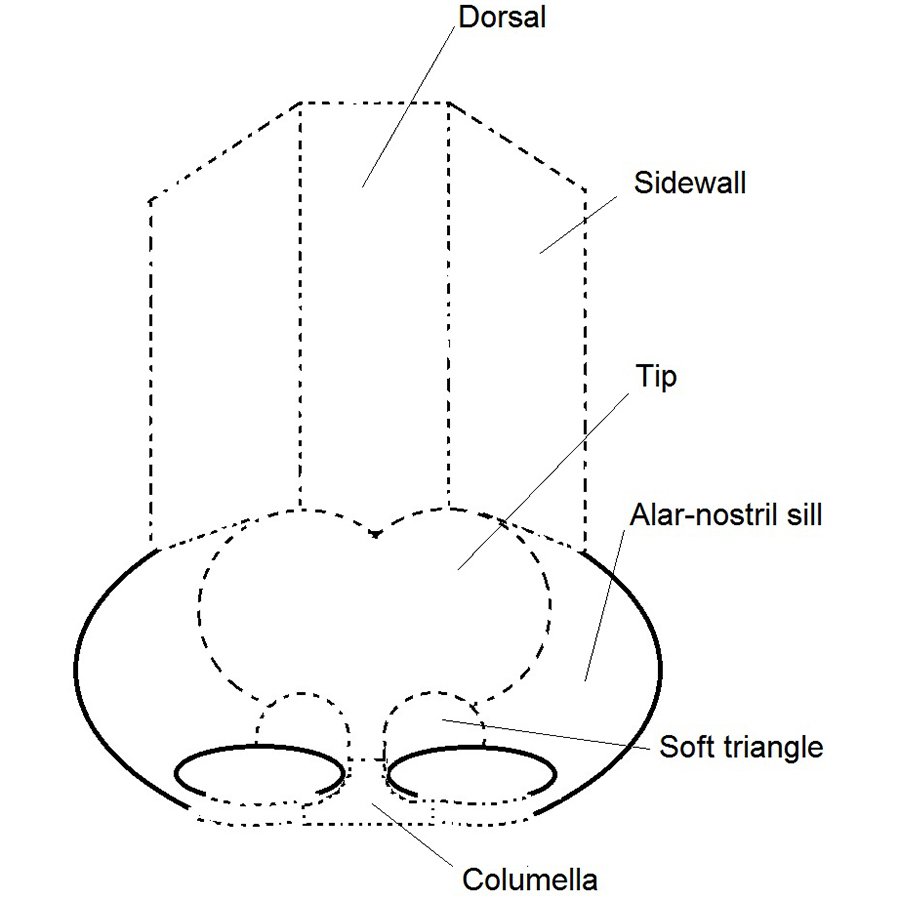
Rhinoplasty, widely known as a nose job or nose reshaping, is surgery that changes the shape, size or structure of the nose. Surgeons who perform it are trained in plastic surgery or facial plastic surgery. The operation works on the bone and cartilage that form the nasal framework, and on the skin that drapes over it.
Source: Cleveland Clinic, MedlinePlus
People choose rhinoplasty for two broad reasons. Cosmetic rhinoplasty aims to improve how the nose looks and how it balances with the rest of the face. Functional rhinoplasty restores form and function after injury, disease, cancer treatment or burns, corrects birth defects, and can fix structural problems that block breathing, such as a deviated septum. Many operations combine both goals.
Source: Cleveland Clinic, ASPS
What it can change
- The overall size of the nose relative to the face
- The width of the bridge, or a hump or dip on it
- The shape of the tip, including a drooping, bulbous or upturned tip
- Large, wide or upturned nostrils
- The angle between the nose and the upper lip
- Asymmetry, and deformities after an injury
Source: ASPS, MedlinePlus
Because every face is a little asymmetric, the American Society of Plastic Surgeons (ASPS) notes that results may not be perfectly symmetric; the goal is balance and proportion rather than a flawless mirror image.
Source: ASPS
Types of rhinoplasty
Open vs. closed rhinoplasty
In closed rhinoplasty all incisions are hidden inside the nostrils, which leaves no visible external scar; it is typically used for smaller changes. In open rhinoplasty the surgeon adds a small cut across the columella (the strip of skin between the nostrils), lifts the skin and gets a full view of the nasal structures. The open approach is preferred for major reshaping, tip work and many revision cases. The British Association of Plastic, Reconstructive and Aesthetic Surgeons (BAPRAS) notes that the open approach can improve accuracy at the tip but brings more swelling and a longer recovery.
Source: Cleveland Clinic, MedlinePlus, BAPRAS
A systematic review of 49 studies (11,035 operations) found reoperation rates of 2.73% after primary open and 1.56% after primary closed complete rhinoplasty, a difference that was not statistically significant. The authors concluded that neither approach is clearly better in terms of reoperation.
Source: PMC
Other variations
- Functional rhinoplasty / septorhinoplasty — reshaping combined with correction of the septum to improve airflow.
- Augmentation rhinoplasty — building up a flat bridge or tip with cartilage grafts or, occasionally, silicone implants.
- Secondary (revision) rhinoplasty — surgery to correct problems that remain or appear after a first operation; it is often more complex.
- Nonsurgical (filler) rhinoplasty — injections that temporarily smooth bumps or lift a tip; it is not surgery and is covered under alternatives below.
Source: Cleveland Clinic, BAPRAS
Who is a good candidate (and who is not)
According to Cleveland Clinic, a good candidate for rhinoplasty has finished growing, is in good general health, does not smoke, has realistic expectations about what surgery can and cannot do, and wants the operation for their own reasons rather than to please someone else.
Source: Cleveland Clinic
Age matters because the nasal bones must be fully developed. MedlinePlus notes that cosmetic nose surgery is usually scheduled after nasal growth ends, around age 15 to 16 for girls and later for boys. Functional surgery after an injury may be considered on a different timeline, as decided by the surgeon.
Source: MedlinePlus
Results also depend on factors you cannot change, such as the size of the nose, the thickness and condition of the skin, and age. BAPRAS points out that a concern blamed on the nose is sometimes caused by the position of the chin or jaw, and that surgery cannot fix emotional or social problems. Some surgeons ask patients to see a clinical psychologist before going ahead.
Source: BAPRAS
Body image screening
Body dysmorphic disorder (BDD), a condition in which a person is preoccupied with a perceived flaw, appears to be common among people seeking rhinoplasty. A 2024 study of 340 people in Saudi Arabia found that 37.6% screened positive, and it cites earlier figures of 32% among US and 47% among Belgian rhinoplasty candidates. Screening tools differ, so figures vary between studies. The authors note that people with BDD tend to be less satisfied after cosmetic rhinoplasty and may seek repeated surgery, and they recommend screening before the operation.
Source: PMC
Preparing for rhinoplasty
The process starts with a consultation. The surgeon examines and measures your face, takes photographs, explains the options and likely results, and discusses the risks. It helps to bring a list of every medicine and supplement you take, with doses, and photos of nose shapes you like, so you and the surgeon can agree on a realistic plan.
Source: Cleveland Clinic
In the weeks before surgery
- Have a medical check to make sure surgery is safe for you.
- Stop blood-thinning medicines only as your surgeon directs.
- Stop smoking 2 to 3 weeks before and after the operation, because smoking slows healing.
- Arrange for someone to drive you home and stay with you the first night.
Source: MedlinePlus, Cleveland Clinic
The NHS advises booking a consultation with the person who will actually perform the procedure, getting a clear explanation of the risks, recovery and how long results last, and not paying until after that consultation. You should be given time to think before deciding.
Source: NHS
How rhinoplasty is done, step by step
Rhinoplasty is performed in a hospital, an outpatient surgery center or an accredited office facility, and usually takes 1 to 3 hours. BAPRAS gives a range of 90 to 180 minutes depending on the technique.
Source: Cleveland Clinic, MedlinePlus, BAPRAS
Anesthesia
The operation is done either under general anesthesia, so you are asleep, or under local anesthesia with sedation, which numbs the nose while you stay relaxed but not fully asleep. The choice depends on the extent of surgery and the surgeon’s and anesthetist’s advice.
Source: Cleveland Clinic, MedlinePlus
The steps
- Incisions — made inside the nostrils (closed approach), or inside the nostrils plus across the columella (open approach).
- Lifting the skin — the skin is raised off the nasal bones and cartilage.
- Reshaping — bone and cartilage are reduced, built up with grafts or rearranged; a crooked septum can be straightened at the same time.
- Closing — the skin is re-draped over the new framework and secured with small stitches.
- Support — an external splint and sometimes internal splints or packing are placed to hold the new shape and support the septum.
Source: Cleveland Clinic, MedlinePlus, ASPS
In the US, most people go home the same day. BAPRAS, describing UK practice, says patients usually stay one night and occasionally two, so the length of stay varies between countries and hospitals.
Source: Cleveland Clinic, MedlinePlus, BAPRAS
Rhinoplasty recovery timeline
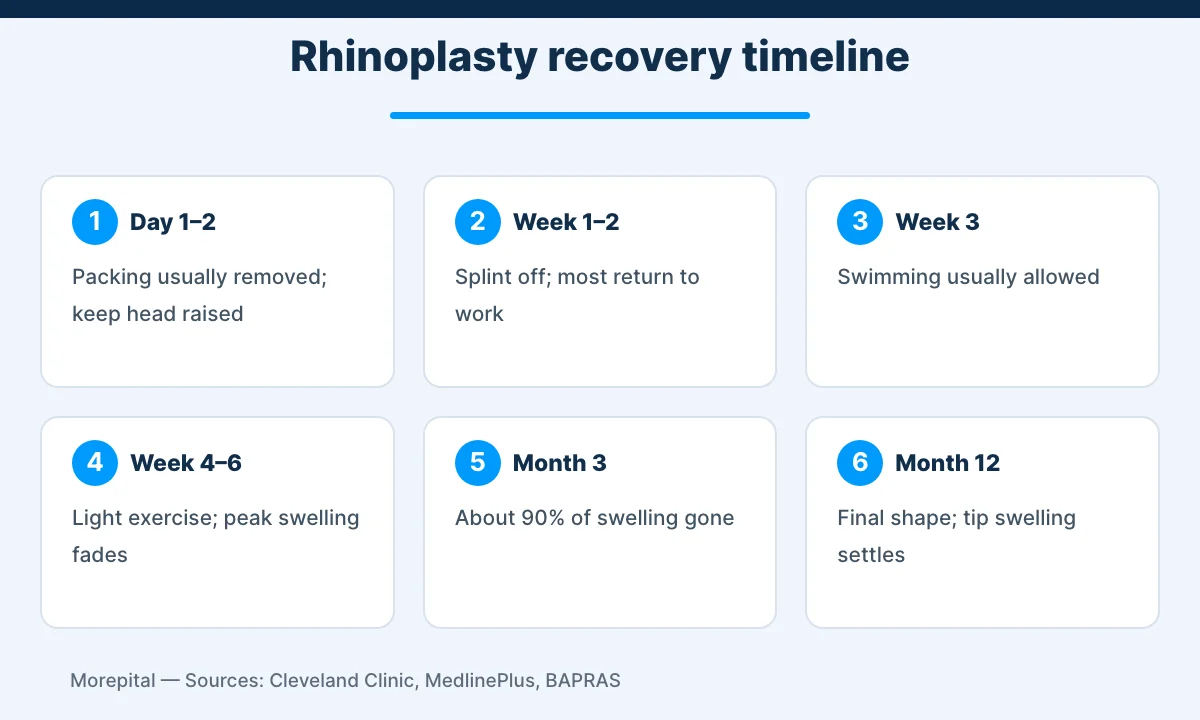
Pain after the operation is usually mild to moderate and eases within a few days to a week; your surgeon will advise on painkillers. Swelling, a blocked feeling and headaches are common at first. If the nasal bones were broken and reset, bruising around the eyes typically lasts 7 to 10 days, with yellow discoloration for up to about 20 days.
Source: Cleveland Clinic, MedlinePlus, BAPRAS
| Time after surgery | What to expect |
|---|---|
| First 24–48 hours | Any gauze packing is usually removed (MedlinePlus notes some packing stays 3–5 days); keep the head raised |
| 3–5 days | Gentle walking is fine |
| 1–2 weeks | Splint removed; most people return to work or school |
| 3 weeks | Swimming usually allowed (BAPRAS) |
| 4–6 weeks | Peak swelling fades; light exercise and lifting can resume |
| About 3 months | Roughly 90% of swelling has gone |
| Up to 12 months or longer | Tip swelling and numbness settle; the final shape appears |
Source: Cleveland Clinic, MedlinePlus, BAPRAS
Tips for healing
- Use cool compresses (not ice directly) on the cheeks and under the eyes.
- Sleep with your head elevated.
- Do not blow your nose, and avoid knocks to the face.
- Keep glasses from resting on the nose until your surgeon allows it.
- Limit sun exposure and avoid strenuous exercise for 4 to 6 weeks.
Source: Cleveland Clinic, BAPRAS
One side of the nose may swell more than the other for a few weeks; this is a normal part of healing. Swelling can come and go during the first year and is often worse in the morning.
Source: Cleveland Clinic, ASPS
Results and how long they last
A change in shape is usually visible about a week after the splint comes off, but the nose keeps refining for a long time. Most swelling improves within 2 to 3 months, while the tip may stay swollen and numb for several months. Full results can take a year or longer. For tip surgery, BAPRAS estimates that about 60% of the change is visible at 3 weeks and the remaining 40% develops over the following months.
Source: Cleveland Clinic, MedlinePlus, BAPRAS
The structural changes are considered permanent. For functional surgery to correct a deviated septum, Cleveland Clinic notes that improved breathing is usually noticed within about six weeks. The nose will still change gradually with normal aging.
Source: Cleveland Clinic, ASPS
Revision rates
Some people need a second operation to fine-tune the result. Reported revision rates vary widely: Cleveland Clinic cites about 15%, a 2023 review describes an average of around 9% with figures up to 17% in the literature, and a large systematic review found reoperation rates below 3% after primary surgery. The variation reflects differences in study design, follow-up and how revision is defined. Most surgeons wait until healing is complete before considering a revision, and BAPRAS advises asking in advance about the conditions and cost of any re-operation.
Source: Cleveland Clinic, PMC, PMC, BAPRAS
Risks and complications
Like any operation, nose surgery carries general surgical risks, including reactions to anesthesia or medicines, bleeding, infection and bruising. Risks more specific to nose surgery include:
Source: MedlinePlus, ASPS
- Breathing problems — nasal breathing can occasionally become worse.
- Nosebleeds — minor bleeding is common; heavy bleeding is very rare but can be serious.
- Septal perforation — a rare hole in the septum that may need more surgery and sometimes cannot be fully repaired.
- Contour irregularities — small bumps of bone or cartilage that can be felt or seen.
- Loss of nasal support — collapse of the structure, a particular risk after repeated operations.
- Numbness or pain — altered skin sensation, or pain lasting several weeks.
- Skin changes — discoloration, swelling, or small visible blood vessels that may be permanent.
- Change in sense of smell.
- Scarring and poor wound healing — mainly with the open approach’s columellar incision.
- Unsatisfactory appearance and the possible need for revision surgery.
Source: MedlinePlus, ASPS, BAPRAS, Cleveland Clinic
Incisions made inside the nose leave no visible scar. Your surgeon should explain the risks in detail and ask you to sign consent forms confirming that you understand them.
Source: MedlinePlus, ASPS
Alternatives to rhinoplasty
Septoplasty
If the main problem is a blocked nose rather than its appearance, septoplasty may be enough. It straightens a crooked septum by repositioning, trimming or removing cartilage and bone inside the nose, takes about 1 to 1.5 hours, and usually does not change the outer shape. It can be done alone or together with rhinoplasty (septorhinoplasty).
Source: MedlinePlus, Cleveland Clinic
Dermal fillers (nonsurgical rhinoplasty)
Injectable fillers can temporarily smooth a bump, fill a dip or lift a slightly drooping tip without surgery. Results are not permanent, and repeat treatments are needed because the body absorbs many fillers over time. The US Food and Drug Administration (FDA) warns that injecting fillers into a blood vessel can block blood flow and cause tissue death, vision problems including blindness, or stroke, and it lists the nose among areas where it recommends against injection because this use is not FDA-approved. Rules differ in other countries, so discuss safety carefully with a qualified doctor.
Source: Cleveland Clinic, FDA
Fillers are also used by some surgeons to correct small irregularities after surgical rhinoplasty. In one large single-clinic review of 2,088 such patients, 1.1% had a vascular emergency that required treatment to dissolve the filler, showing that even experienced injectors see this complication.
Source: PMC
Other options
When the real concern is facial balance, changing the chin or jaw may sometimes help more than changing the nose. Accepting the current shape is also a valid choice, particularly when surgery would not meet expectations.
Source: BAPRAS
Choosing a surgeon and rhinoplasty abroad
Check that your surgeon is fully registered and trained in plastic or facial plastic surgery, and that the clinic is licensed by the national regulator. In the UK, for example, doctors appear on the General Medical Council register and independent clinics must be registered with the Care Quality Commission; other countries have their own registers. Ask how many nose operations the surgeon has done, which professional associations they belong to, what the most common complications are, who provides aftercare, what happens if you are unhappy, and what the full cost includes.
Source: NHS, Cleveland Clinic
If you are traveling for surgery
- Research how clinics in that country are regulated and how standards are enforced.
- Have a consultation with the surgeon, not just a sales advisor, and make sure you share a language.
- Ask to see before-and-after photos of the surgeon’s own work.
- Find out where follow-up will take place and how you would return if more surgery is needed.
- Check insurance: travel insurance usually does not cover complications of surgery.
- Do not plan a holiday straight after surgery; rest and avoid alcohol, sun and swimming.
- The NHS advises avoiding flying for 7 to 10 days after facial procedures because of the risk of blood clots.
Source: NHS
In many public health systems, purely cosmetic nose surgery is not funded. BAPRAS notes that in the UK, surgery after an injury or to improve breathing is sometimes available on the NHS, while cosmetic nose surgery must usually be arranged privately.
Source: BAPRAS
When to call your doctor
Some swelling, stuffiness and mild discomfort are expected after nose surgery. Contact your surgeon promptly if you notice anything that seems to be getting worse rather than better.
Source: Cleveland Clinic
- You have difficulty breathing
- A nosebleed will not stop
- You have severe pain that painkillers do not control
- You develop fever, yellow discharge or other signs of infection
- You have persistent nausea or vomiting
Source: Cleveland Clinic
Related conditions
Rhinoplasty: frequently asked questions
How long does rhinoplasty recovery take?
Most people return to work or school within 1 to 2 weeks, once the splint is removed. Visible swelling fades over 2 to 3 months, but the final shape can take a year or more to settle.
Source: Cleveland Clinic, MedlinePlus
Is rhinoplasty painful?
Pain is usually mild to moderate and improves within a few days to a week. Congestion, swelling and headaches are common at first, and pain that is severe or getting worse should be reported to your surgeon.
Source: Cleveland Clinic, MedlinePlus
Are rhinoplasty results permanent?
Yes, the changes to bone and cartilage are considered permanent, although the nose still ages naturally. A minority of patients choose revision surgery for small adjustments.
Source: Cleveland Clinic
What is the minimum age for rhinoplasty?
Cosmetic rhinoplasty is usually done once the nose has stopped growing, around 15 to 16 for girls and later for boys. Surgery to repair an injury or breathing problem may follow a different timeline.
Source: MedlinePlus, Cleveland Clinic
Will rhinoplasty leave a scar?
Closed rhinoplasty uses incisions inside the nostrils and leaves no visible scar. Open rhinoplasty adds a small cut across the columella, which usually heals as a fine line.
Source: MedlinePlus, BAPRAS, Cleveland Clinic
What is the difference between rhinoplasty and septoplasty?
Rhinoplasty changes the outside shape of the nose, while septoplasty straightens the internal wall (septum) to improve breathing. The two can be combined in a septorhinoplasty.
Source: Cleveland Clinic, MedlinePlus
Can rhinoplasty fix breathing problems?
Yes. Functional rhinoplasty can correct structural problems such as a deviated septum or injury that block airflow, and improved breathing is usually noticed within about six weeks.
Source: Cleveland Clinic, ASPS
Is a non-surgical nose job safe?
Filler rhinoplasty is temporary and avoids surgery, but injection into a blood vessel can cause tissue death or blindness. The FDA recommends against injecting fillers into the nose because that use is not approved.
Source: FDA, Cleveland Clinic
When can I fly after rhinoplasty?
The NHS advises avoiding flying for 7 to 10 days after facial cosmetic procedures because of the risk of blood clots. Follow your own surgeon's advice for your case.
Source: NHS
Considering rhinoplasty? Contact us for a free consultation about your case.
Sources
- Cleveland Clinic — Rhinoplasty (Nose Job): Surgery, Recovery, Before & After
- MedlinePlus — Rhinoplasty: MedlinePlus Medical Encyclopedia
- ASPS — Rhinoplasty | American Society of Plastic Surgeons
- ASPS — Rhinoplasty Risks and Safety
- ASPS — Rhinoplasty Recovery
- BAPRAS — Rhinoplasty | BAPRAS
- NHS — Cosmetic surgery abroad
- NHS — Choosing who will do your cosmetic procedure
- FDA — Dermal Fillers (Soft Tissue Fillers)
- MedlinePlus — Septoplasty: MedlinePlus Medical Encyclopedia
- PMC — Rhinoplasty Complications and Reoperations: Systematic Review (Int Arch Otorhinolaryngol, 2016)
- PMC — Postoperative Fillers Reduce Revision Rates in Rhinoplasty (Aesthet Surg J Open Forum, 2023)
- PMC — Nonsurgical Correction of Surgical Rhinoplasty Complications with Hyaluronic Acid Fillers: 2088 Cases (PRS Global Open, 2024)
- PMC — High Prevalence of Body Dysmorphic Disorder Among Rhinoplasty Candidates (Cureus, 2024)
This page is part of the Morepital medical reference. It is for general health education and does not replace a consultation with a qualified doctor. Last reviewed: October 2026.