
LASIK
Laser-assisted in situ keratomileusis (laser eye surgery)
LASIK (laser-assisted in situ keratomileusis) is laser eye surgery that permanently reshapes the cornea to correct nearsightedness, farsightedness and astigmatism. The surgeon lifts a thin corneal flap, an excimer laser reshapes the tissue underneath, and the flap is replaced without stitches. Cleveland Clinic reports that about 9 in 10 people reach 20/20 vision and nearly everyone reaches 20/40 or better.
Source: FDA, Cleveland Clinic, MedlinePlus
- What is LASIK?
- Who is a good candidate for LASIK?
- How to prepare for LASIK
- How LASIK is done, step by step
- LASIK recovery timeline
- LASIK results and how long they last
- LASIK risks and complications
- Alternatives to LASIK
- Choosing a LASIK surgeon and treatment abroad
- When to call your doctor after LASIK
- FAQ
- Sources
What is LASIK?
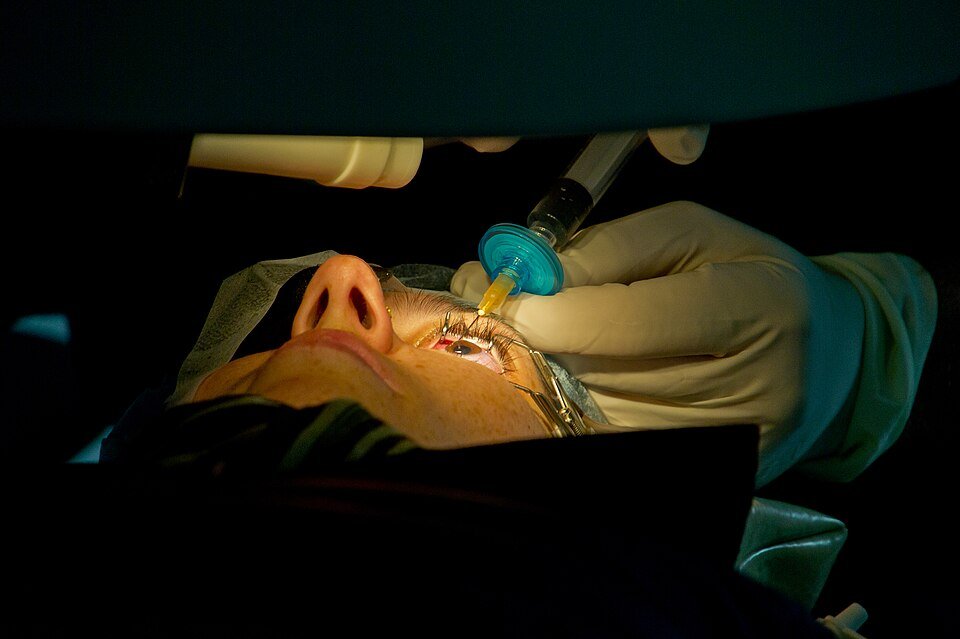
LASIK, short for laser-assisted in situ keratomileusis, is a type of refractive surgery. It uses an excimer laser to permanently reshape the cornea, the clear dome at the front of the eye, so that light focuses correctly on the retina.
Source: FDA, MedlinePlus, Cleveland Clinic
LASIK treats the three main refractive errors: nearsightedness (myopia), farsightedness (hyperopia) and astigmatism. Sources differ on presbyopia, the age-related loss of near focus that makes most people reach for reading glasses in their 40s: Cleveland Clinic lists presbyopia among the problems LASIK can address, while MedlinePlus explains that LASIK cannot give one eye both near and far focus, although a strategy called monovision can reduce the need for readers.
Source: MedlinePlus, Cleveland Clinic
How LASIK differs from other laser eye surgery
The defining feature of LASIK is a thin, hinged flap cut in the top layer of the cornea. The surgeon folds the flap back, the laser removes a precise amount of tissue from the middle corneal layer (the stroma), and the flap is laid back down without stitches. Early LASIK cut the flap with an automated blade (microkeratome); MedlinePlus says a femtosecond laser is now the more common way, which is why the method is marketed as “bladeless” or “all-laser” LASIK. The FDA notes that surgeons still do not fully agree on which flap method is better.
Source: FDA, MedlinePlus, FDA
The first laser was approved for LASIK in the United States in 1998, so the FDA notes that very long-term data are still limited. In the UK, the NHS says laser eye surgery is usually only available privately, except when sight problems cannot be corrected with glasses or contact lenses or when an eye condition threatens vision.
Who is a good candidate for LASIK?
Not everyone who wants to stop wearing glasses is suitable for LASIK. An ophthalmologist decides after a full eye examination. A good candidate usually:
- Is at least 18 years old; some lasers are approved only from age 21
- Has had a stable prescription for at least a year
- Has a refractive error within the range the laser can treat
- Has healthy eyes and corneas that are not too thin
- Understands that glasses or contacts may still be needed and that some complications cannot be avoided
Source: Cleveland Clinic, Merck Manual Professional, MedlinePlus, FDA
No laser is approved for LASIK in people under 18. MedlinePlus notes nearsightedness can progress into the mid-to-late 20s.
Source: FDA, MedlinePlus
Who should not have LASIK
The FDA, MedlinePlus and the Merck Manual list conditions that usually rule LASIK out or call for extra caution:
- A prescription that changed in the past year, which is more common in people in their early 20s or younger, during pregnancy or breastfeeding, and in people with diabetes
- A prescription outside the range the laser can correct; results are less predictable with very large errors
- Severe dry eye or other active eye disease
- Corneas that are too thin
- Keratoconus, a condition in which the cornea thins and bulges into a cone shape
- Glaucoma, raised eye pressure or cataract, which need careful discussion with the surgeon
- Autoimmune or immune conditions that slow healing, such as lupus, rheumatoid arthritis or HIV, and diabetes
- Medicines that affect healing or vision, such as isotretinoin, retinoic acid, amiodarone, sumatriptan or oral steroids
- A past eye infection with herpes simplex or shingles, uveitis or iritis, or previous eye injury or surgery
- Regular contact sports with frequent blows to the face, such as boxing, wrestling or martial arts
Source: FDA, MedlinePlus, Merck Manual Professional, FDA
Your surgeon should also check for eyelid inflammation (blepharitis) and large pupils, which raise the risk of infection and of night glare and halos. Some jobs restrict certain refractive procedures, so check before you book. In the U.S., most medical insurance does not cover LASIK.
Source: FDA
How to prepare for LASIK
Preparation starts weeks before the surgery date with a baseline evaluation. Contact lenses change the shape of the cornea, so you will be asked to switch to glasses full time before this exam. The FDA advises stopping:
- Soft lenses at least 2 weeks before the evaluation
- Toric soft lenses or rigid gas-permeable lenses at least 3 weeks before
- Hard lenses at least 4 weeks before
Source: FDA
At the evaluation, the eye team checks your overall eye health, the stability and size of your refractive error, pupil size in light and dark, and signs of dry eye. They measure the curvature and thickness of your cornea, and usually run a wavefront test; these measurements are used to calculate how much tissue the laser removes. Tell the doctor about every medical and eye condition, all medicines (including over-the-counter ones) and any drug allergies.
Source: FDA, MedlinePlus
Your doctor should explain the risks, benefits and alternatives, and you will sign a consent form. The FDA encourages patients to take their time and not feel pressured. The day before surgery, stop using creams, lotions, makeup and perfume, and you may be asked to clean your eyelashes. Arrange for someone to drive you home, because you may be given a relaxing medicine and your vision will be blurry.
Source: FDA, MedlinePlus, Cleveland Clinic
How LASIK is done, step by step
LASIK is an outpatient procedure performed in an eye clinic or surgery center. You stay awake; numbing eye drops are the anesthetic, and many surgeons also give a mild sedative to help you relax. The whole visit in the laser room usually takes less than 30 minutes, about 10 to 15 minutes per eye, and Cleveland Clinic says you look at the laser light for fewer than 30 seconds.
Source: FDA, MedlinePlus, Cleveland Clinic, NHS
- Numbing and positioning. You lie back in a reclining chair under the laser. Numbing drops are placed in the eye and a lid holder (speculum) keeps your eyelids open.
- Creating the flap. A suction ring holds the eye steady. Your vision may dim for a moment and you may feel pressure. A femtosecond laser or a microkeratome blade then creates a thin flap in the cornea, leaving a hinge at one end.
- Lifting the flap. The surgeon folds the flap back to expose the tissue underneath.
- Reshaping the cornea. You stare at a light while a computer-controlled excimer laser removes microscopic amounts of tissue based on your measurements. You may hear a clicking sound and notice an odd smell; Cleveland Clinic explains this is a chemical reaction, not the eye burning.
- Replacing the flap. The flap is laid back in place. It stays hinged and needs no stitches.
- Protecting the eye. A clear shield is placed over the eye to stop you rubbing it, especially while you sleep.
Source: FDA, Cleveland Clinic, MedlinePlus, FDA
The FDA notes that if you cannot keep your gaze on a fixed target for at least 60 seconds, you may not be a good candidate. Both eyes are often treated on the same day; the FDA points out that this carries more risk than separate sessions, because the surgeon cannot see how the first eye heals before treating the second.
Types of LASIK
Conventional LASIK programs the laser from your glasses prescription. Wavefront-guided LASIK uses a detailed map of how your eye bends light. According to the FDA, it raises subtle optical distortions (higher-order aberrations) less than conventional LASIK, and a few studies found slightly more patients reaching 20/20. Bladeless (all-laser) LASIK refers only to making the flap with a laser instead of a blade.
Source: FDA, MedlinePlus
LASIK recovery timeline
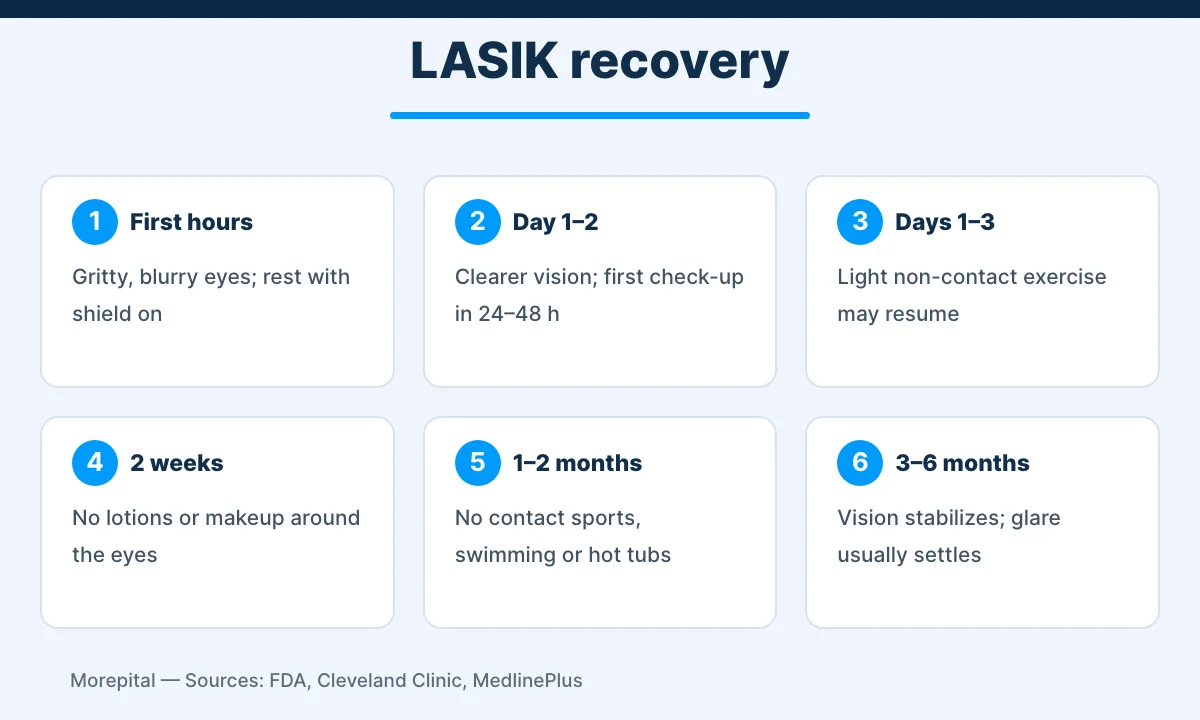
Most people go home soon after surgery and rest for the remainder of the day. Burning, itching, a gritty feeling, tearing and hazy vision are common at first, usually fading within about 6 hours. Do not rub your eye, as that can move the flap. You will have a check-up within 24 to 48 hours, and then regular visits for at least the first six months.
Source: FDA, MedlinePlus
Expect lubricating drops for dryness, antibiotic drops to prevent infection, and steroid drops to calm inflammation. Do not drive until your doctor confirms your vision is good enough; the NHS also advises against night driving until your eyes have recovered.
Source: Cleveland Clinic, NHS, MedlinePlus
| Time after LASIK | What to expect / what to avoid |
|---|---|
| First hours | Scratchiness, burning and blurry vision; rest with the shield on |
| Day 1–2 | Vision usually much clearer; first follow-up visit within 24–48 hours |
| Days 1–3 | Light non-contact exercise can usually resume |
| Up to 2 weeks | No lotions, creams or makeup around the eyes |
| At least 4 weeks | No strenuous contact sports (boxing, football, karate) |
| 1–2 months | No swimming, hot tubs or whirlpools |
| 3–6 months | Vision fully stabilizes; glare and halos usually settle by about 6 months |
| Up to 1 year (rare) | Dry eye can linger in some people |
Source: FDA, Cleveland Clinic, MedlinePlus
When can I go back to work?
Sources differ slightly. The Merck Manual says most patients notice a big improvement the next day and can usually return to work, while the FDA suggests planning a few days off. Ask your surgeon what fits your job.
Source: Merck Manual Professional, FDA
LASIK results and how long they last
Most people notice clearer vision within a day. Cleveland Clinic states that nearly everyone reaches 20/40 or better, the U.S. standard for driving without glasses, and that about nine in ten people reach 20/20. The Merck Manual gives a broader figure: more than 95% of refractive surgery patients no longer need lenses for distance vision, a number that covers all refractive procedures, not LASIK alone.
Source: Cleveland Clinic, Merck Manual Professional
Large reviews of published studies support these figures. A 2016 review of 97 studies (67,893 eyes) published between 2008 and 2015 found that 99.5% of eyes saw better than 20/40 without correction, 90.9% were within 0.5 diopter of the intended target, and 0.61% lost two or more lines of best-corrected vision. In the studies that asked, 1.2% of patients were dissatisfied. An earlier systematic review reported an average satisfaction rate of 95.4%.
Source: J Cataract Refract Surg (PubMed), Ophthalmology (PubMed)
Is LASIK permanent?
The change to the cornea is permanent, and most people keep a stable improvement for years. However, the eye keeps aging. LASIK does not stop presbyopia, so MedlinePlus says most people will likely need reading glasses around age 45, with or without surgery. The FDA adds that results are less predictable for very large prescriptions, and in farsighted patients the benefit may fade with age.
Source: MedlinePlus, Cleveland Clinic, FDA
A small number of patients are under- or over-corrected and need glasses, contact lenses or a second laser treatment (an enhancement). The FDA advises waiting until measurements are stable on two visits at least 3 months apart before re-operating, and notes that an enhancement may sharpen distance vision but is unlikely to reduce glare or halos.
Source: FDA, MedlinePlus
LASIK risks and complications
LASIK has a strong safety record, but no surgery is risk-free. The Merck Manual estimates the chance of vision loss at under 1% in well-selected patients. Common side effects are usually temporary; the NHS says they tend to improve within a few months:
- Dry, gritty or irritated eyes
- Glare, halos and starbursts around lights, and reduced night vision
- Blurry or fluctuating vision and light sensitivity
- Small red or pink patches on the white of the eye
Source: Cleveland Clinic, Merck Manual Professional, NHS, MedlinePlus
Dry eye
Dry eye is the most frequent problem after LASIK because making the flap cuts corneal nerves that help trigger tear production and blinking. A 2018 review found that almost everyone has some dryness early on, peaking about a week after surgery, with symptoms in roughly 59% of patients at one month in one study. For most people it settles within months; corneal sensation usually returns by about a year. The FDA warns that, in some people, severe dry eye can be permanent. Having dry eye before surgery is the strongest risk factor.
Source: J Ophthalmol (PMC), FDA, Cleveland Clinic
Flap and surgical complications
Problems with the flap, such as an irregular cut or a flap that shifts, are specific to LASIK and can often be fixed by repositioning it. Rarely, a device error during surgery can stop the procedure or damage the eye. After surgery, inflammation or infection may need extra treatment and, very rarely, can cause lasting vision loss.
Source: Merck Manual Professional, FDA
Corneal ectasia
Ectasia is a rare but serious late complication in which a cornea left too thin gradually weakens and bulges, causing blurring, worsening nearsightedness and irregular astigmatism. Reported rates vary between studies: a review of 30,167 eyes found 0.033% over up to 8 years, while a single-surgeon series of 4,027 eyes reported 0.57%. Thin corneas, an irregular corneal map before surgery, a thin remaining stromal bed and large corrections were the main risk factors, which is why careful screening matters.
Source: Merck Manual Professional, Semin Ophthalmol (PubMed), Clin Ophthalmol (PMC)
Alternatives to LASIK
Glasses and contact lenses remain the non-surgical option, and the FDA urges people to weigh LASIK’s risks against their own priorities. If you are not a good LASIK candidate, other refractive procedures may suit you:
- PRK (photorefractive keratectomy): the outer skin cells of the cornea (epithelium) are removed and the laser reshapes the surface, so there is no flap. A bandage contact lens is worn for the 3 to 4 days the surface takes to regrow. It may suit people with thin or flat corneas, or athletes and people in jobs where a flap could be knocked loose. Final vision is similar to LASIK, but the first days are more painful, vision takes weeks to months to settle, and haze is more likely.
- SMILE (small incision lenticule extraction): a femtosecond laser shapes a small disc of tissue inside the cornea, which is removed through a tiny incision with no flap. It treats nearsightedness and astigmatism but not farsightedness. The Merck Manual reports results similar to LASIK with less effect on corneal nerves.
- Implantable collamer lens (phakic IOL): a lens implanted inside the eye while the natural lens is kept, used for moderate to high nearsightedness (about 4 to 20 diopters) that cannot safely be corrected on the cornea. It does not thin the cornea, but it is intraocular surgery with its own risks, such as cataract, glaucoma and infection.
- Refractive lens exchange: the natural lens is replaced with an artificial one using the same technique as cataract surgery; Merck describes it as an option for people with presbyopia who are not at high risk of retinal detachment.
Source: FDA, Harvard Health, Merck Manual Professional
For people over 40, monovision corrects one eye for distance and the other for near. It can reduce depth perception and quality of vision, especially at night, so the FDA recommends trying it first with contact lenses.
Source: FDA
Choosing a LASIK surgeon and treatment abroad
Outcomes depend on the laser, the screening and the surgeon. The FDA advises patients to:
- Compare risks and benefits, which vary with the procedure, the laser maker and the surgeon’s experience
- Not choose on price alone or settle for the first clinic you find
- Ask for the laser manufacturer’s patient information booklet and for the surgeon’s own results and complication rates
- Be wary of “20/20 or your money back” guarantees, package deals and offers that seem too good to be true; there are no guarantees in medicine
Source: FDA
Choose an experienced eye surgeon and expect careful screening for the conditions listed above; the FDA notes that most patients are pleased with their results, especially when carefully screened and treated by an experienced surgeon. The NHS notes you should first have a consultation with the surgeon. If you travel abroad for LASIK, plan for the recommended follow-up schedule, with a check-up within 24 to 48 hours and further visits over at least the next six months.
When to call your doctor after LASIK
Mild discomfort, watering and blurry vision in the first hours are expected. Contact your eye surgeon promptly if side effects get worse instead of better, or if you notice any new or unusual eye symptom, because some problems can lead to vision loss if not treated early.
Source: FDA, Cleveland Clinic, MedlinePlus
- You have severe eye pain
- Your vision suddenly gets worse or blurs
- Floaters suddenly appear or increase, or you see flashes of light
- A dark curtain or shadow moves across your vision
Source: Cleveland Clinic, FDA, NHS
LASIK: frequently asked questions
Does LASIK hurt?
No, the procedure should not be painful. Numbing drops are used and you may feel pressure when the suction ring is applied. Afterward, burning or a gritty feeling usually lasts a few hours.
Source: Cleveland Clinic, FDA, MedlinePlus
How long does LASIK take?
The laser-room visit usually takes under 30 minutes, about 10 to 15 minutes per eye. Cleveland Clinic says you look at the laser light for fewer than 30 seconds.
Source: FDA, MedlinePlus, Cleveland Clinic
How long does it take to recover from LASIK?
Vision usually improves within a day or two, and most people resume normal life within days. Avoid eye makeup for up to 2 weeks, contact sports for at least 4 weeks and swimming for 1 to 2 months. Full stabilization can take 3 to 6 months.
Source: FDA, Cleveland Clinic, MedlinePlus
Is LASIK permanent?
The change to the cornea is permanent and most people keep stable vision for years. Eyes still age, so most people need reading glasses around their mid-40s, and a few need an enhancement.
Source: MedlinePlus, Cleveland Clinic, FDA
What is the success rate of LASIK?
Cleveland Clinic says about 9 in 10 people reach 20/20 and nearly everyone reaches 20/40 or better. A review of nearly 68,000 eyes found 99.5% saw better than 20/40 and only 1.2% of patients were dissatisfied.
Can LASIK correct astigmatism?
Yes. LASIK treats nearsightedness, farsightedness and astigmatism, as long as the error is within the range the laser can treat.
Source: MedlinePlus, FDA, Cleveland Clinic
Can you have LASIK with keratoconus?
Usually not. The FDA lists keratoconus as a condition to discuss carefully with your surgeon, and thin or irregular corneas are the main risk factors for ectasia, a weakening and bulging of the cornea after LASIK.
Source: FDA, Merck Manual Professional, Semin Ophthalmol (PubMed)
What is the minimum age for LASIK?
At least 18, since no laser is approved for LASIK in younger people; some lasers are approved only from 21, and the prescription should have been stable for about a year.
Source: FDA, MedlinePlus, Cleveland Clinic
What is the most common side effect of LASIK?
Dry eye. Almost everyone has some dryness early on, and it usually settles within months, but in a small number it lasts longer or becomes permanent.
Source: J Ophthalmol (PMC), Cleveland Clinic, FDA
Is LASIK or PRK better?
Neither is better for everyone. Final vision is similar. PRK avoids a flap and may suit thin corneas or contact sports, but recovery is slower and more painful.
Source: Harvard Health, Merck Manual Professional
Ask about LASIK
Sources
- FDA — LASIK
- FDA — What should I expect before, during, and after surgery?
- FDA — What are the risks and how can I find the right doctor for me?
- FDA — When is LASIK not for me?
- FDA — LASIK — FAQs
- Cleveland Clinic — LASIK Eye Surgery: What It Is, Procedure & Recovery
- MedlinePlus — LASIK eye surgery
- NHS — Laser eye surgery and lens surgery
- Merck Manual Professional — Refractive Surgery
- Harvard Health — Surgical alternatives to LASIK
- J Cataract Refract Surg (PubMed) — Modern laser in situ keratomileusis outcomes (Sandoval et al., 2016)
- Ophthalmology (PubMed) — LASIK world literature review: quality of life and patient satisfaction (Solomon et al., 2009)
- J Ophthalmol (PMC) — Dry Eye Post-Laser-Assisted In Situ Keratomileusis: Major Review and Latest Updates (Cohen & Spierer, 2018)
- Clin Ophthalmol (PMC) — Corneal ectasia after myopic laser in situ keratomileusis: a long-term study (Spadea, 2012)
- Semin Ophthalmol (PubMed) — Incidence and Clinical Characteristics of Post LASIK Ectasia: A Review of over 30,000 LASIK Cases (Bohac et al., 2018)
This page is part of the Morepital medical reference. It is for general health education and does not replace a consultation with a qualified doctor. Last reviewed: October 2026.