
Tooth abscess
Dental abscess (periapical / periodontal abscess)
A tooth abscess is a pocket of pus caused by a bacterial infection inside a tooth, at the tip of its root or in the nearby gum, usually after deep decay, a cracked tooth or gum disease. It causes severe, throbbing pain and swelling, will not heal on its own, and needs urgent dental treatment such as drainage, root canal treatment or extraction.
Source: Cleveland Clinic, NHS, MedlinePlus
- What is a tooth abscess?
- Tooth abscess symptoms
- Causes and risk factors
- Types of tooth abscess
- How a tooth abscess is diagnosed
- Tooth abscess treatment options
- Pain relief while you wait for the dentist
- Complications of an untreated tooth abscess
- How to prevent a tooth abscess
- When to see a dentist or seek emergency care
- FAQ
- Sources
What is a tooth abscess?
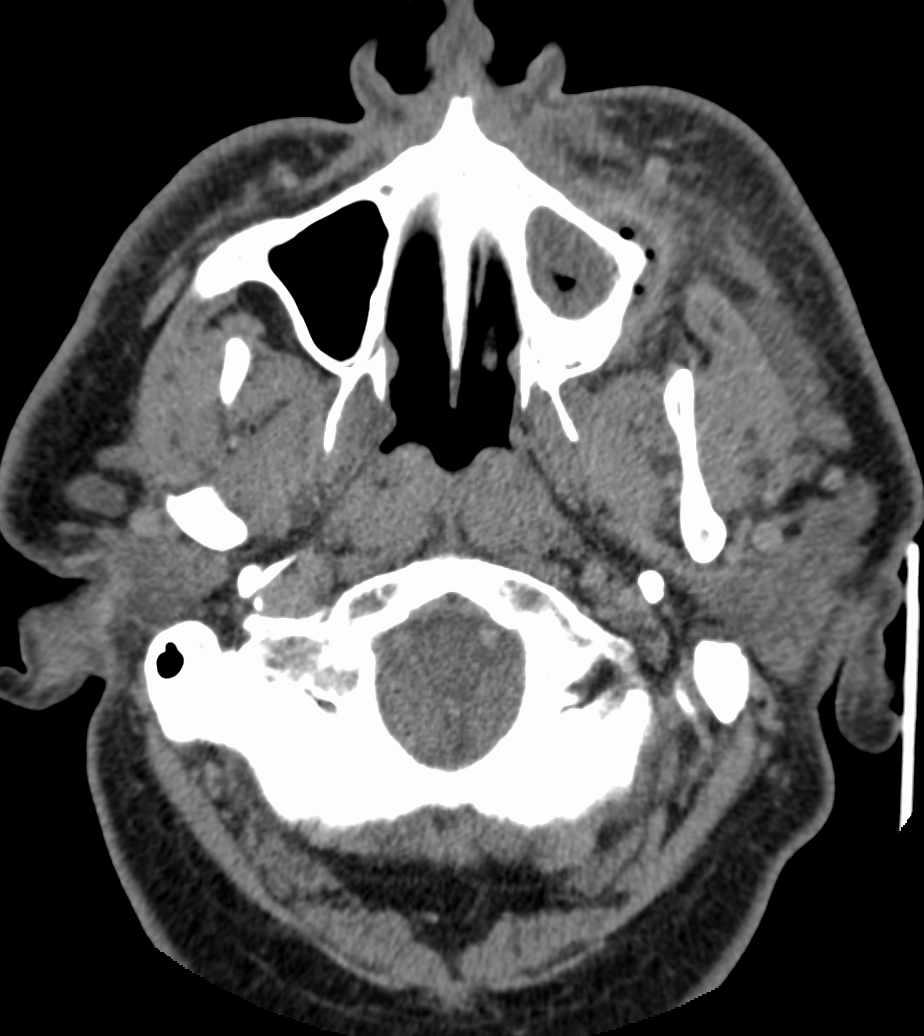
A tooth abscess (also called a dental abscess or abscessed tooth) is a pocket of pus that forms inside a tooth, at the tip of its root, or in the gum next to it. The pus is the result of a bacterial infection: the body sends white blood cells to fight the bacteria, and the mixture of dead tissue, bacteria and immune cells collects in a closed space where it cannot drain. Pressure from that trapped pus is what makes the pain so intense.
Source: Cleveland Clinic, MedlinePlus, NHS
On the gum, an abscess often looks like a red, swollen bump, a boil or a small pimple near the affected tooth. The infection does not stay put. It can travel from the tooth into the surrounding jawbone and neighboring teeth, and from there into the soft tissues of the face and neck. Cleveland Clinic points out that every tooth abscess is an infection, but not every tooth infection becomes an abscess; an abscess signals that the infection has become severe.
Source: Cleveland Clinic, ADA MouthHealthy
Anyone with teeth can develop an abscess, and children and adults are affected about equally. It is not something that clears up by itself. The NHS describes a dental abscess as a problem that needs urgent dental treatment, and UK guidance adds that a GP can give advice but cannot provide the dental care needed to cure it.
Source: nidirect (NHS-adapted), NHS
With prompt treatment most infections are cured and the tooth can often be saved. Left alone, however, an abscessed tooth can lead to tooth loss, bone infection and, rarely, life-threatening spread to other parts of the body.
Source: MedlinePlus, Cleveland Clinic
Tooth abscess symptoms
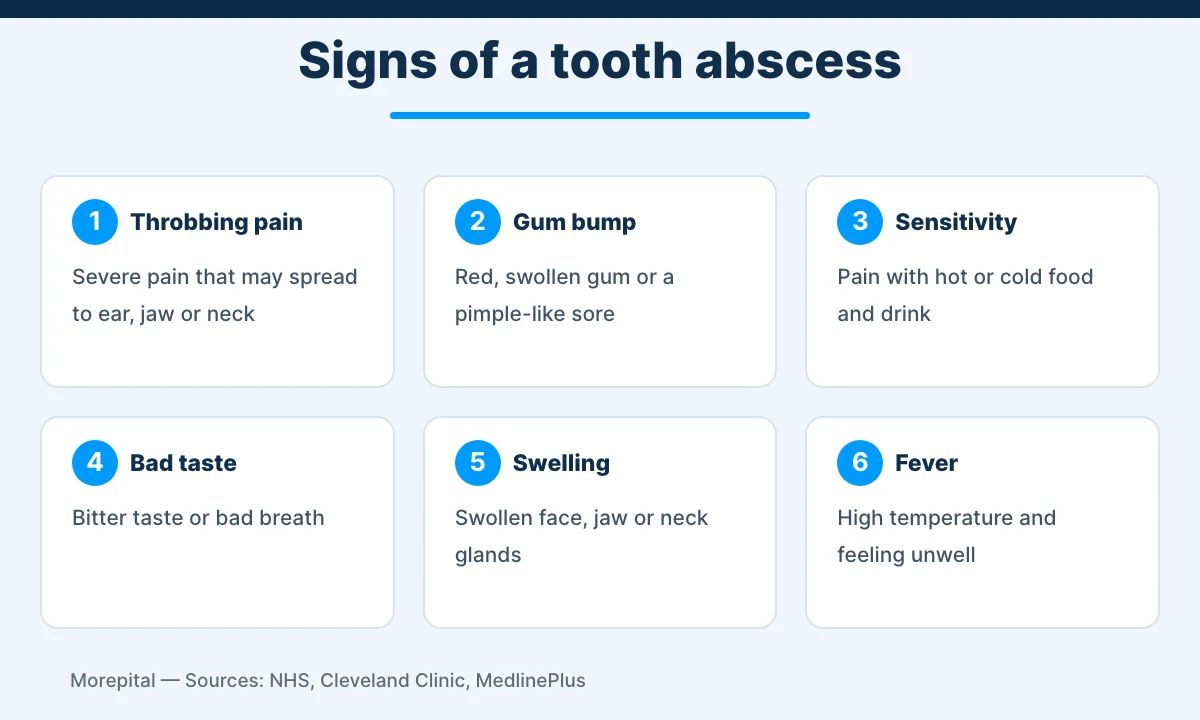
The hallmark symptom is a severe, throbbing toothache or gum pain. It often starts suddenly and can get worse over a few hours or days. The pain may be constant or appear only when you bite or chew, and it can feel sharp, shooting or gnawing. It frequently spreads to the ear, lower jaw or neck on the same side as the affected tooth.
Source: nidirect (NHS-adapted), Cleveland Clinic, MedlinePlus
Common signs
- Intense, throbbing pain in a tooth or the gum around it
- Pain when chewing or when the tooth is tapped
- Sensitivity to hot or cold food and drink
- Red, swollen gums, sometimes with a pimple-like bump over the tooth
- An open, draining sore on the gum that may release a salty or bitter fluid
- Bad breath or an unpleasant, bitter taste in the mouth
- A tooth that feels loose
- Swelling of the face, cheek or jaw
- Swollen glands (lymph nodes) in the neck
- Fever and feeling generally unwell
- Difficulty opening the mouth, chewing or swallowing, and disturbed sleep
Source: NHS, Cleveland Clinic, MedlinePlus, nidirect (NHS-adapted)
When the pain suddenly stops
Pain can ease if the abscess bursts and pressure is released, or if the nerve inside the tooth dies. This does not mean the problem has gone away. Both Cleveland Clinic and MedlinePlus warn that the bacteria keep spreading and destroying tissue, so you still need to see a dentist even when the pain stops.
Source: Cleveland Clinic, MedlinePlus
MedlinePlus singles out swelling of the upper or lower jaw as a very serious sign. Facial swelling, a fever of 38°C (100.4°F) or higher, pain that painkillers do not control and any difficulty breathing suggest that the infection may be spreading.
Source: MedlinePlus, nidirect (NHS-adapted)
Causes and risk factors
A tooth abscess forms when bacteria find a way into a tooth or the tissues around it. Normally the hard outer enamel and the gum seal protect the soft inner pulp, which contains nerves and blood vessels. Once that barrier is breached, bacteria multiply in the pulp, the pulp dies, and pus can collect at the root tip inside the jawbone.
Source: ADA MouthHealthy, MedlinePlus
Main causes
- Deep tooth decay (cavities): acid produced by bacteria wears through enamel and lets infection reach the pulp.
- Broken, chipped or cracked teeth: openings in the tooth give bacteria a direct path inside.
- Gum (periodontal) disease: bacteria gradually work their way into the deeper tissues that hold the tooth.
- Injury to a tooth: a blow can damage the pulp even when no crack is visible.
- An impacted tooth that has not fully come through the gum.
Source: Cleveland Clinic, NHS, MedlinePlus
Risk factors
- Smoking: according to Cleveland Clinic, smokers are about twice as likely to develop a tooth abscess.
- Poor oral hygiene: skipping brushing, flossing and professional cleanings allows bacteria to build up.
- Dry mouth: saliva helps control bacteria, so a lack of it lets them thrive.
- A weakened immune system caused by illness or medicines.
- Radiotherapy or chemotherapy treatment.
Source: Cleveland Clinic, NHS
Types of tooth abscess
Dentists describe abscesses by where they start. The type matters because it points to the cause and the most suitable treatment.
Source: Cleveland Clinic
| Type | Where it forms | Usual cause |
|---|---|---|
| Periapical abscess | At the tip of the tooth root, in the jawbone | Decay or a fracture lets bacteria into the pulp; the infection then spreads to the root tip and surrounding bone |
| Periodontal abscess | In the bone and tissues that support the tooth, beside the root | Usually gum disease; more common in adults |
| Gingival abscess | In the gum only | Usually does not involve the tooth or its supporting structures |
Source: Cleveland Clinic
A periapical abscess is typically treated by dealing with the infected pulp, for example with root canal treatment, while an abscess caused by gum disease may be managed by cleaning out the space between the tooth and the gum. A cracked tooth can also lead to an abscess along the side of the root.
Source: ADA MouthHealthy, Cleveland Clinic
How a tooth abscess is diagnosed
Diagnosis is usually made at a dental visit. The dentist examines the teeth, gums and mouth, looking for swollen red gums, a draining sore or a tender tooth.
Source: MedlinePlus, Cleveland Clinic
- Tapping and pressing: an abscessed tooth is often painful when tapped or pressed.
- Thermal tests: hot or cold stimuli help show whether the pulp is still healthy.
- Dental X-rays: pinpoint the source of the infection and show whether it has spread into the bone.
- CT scan: used if the infection may have spread into the neck, to judge how far it extends.
Source: Cleveland Clinic, MedlinePlus
If you have signs of spreading infection, such as marked facial swelling or trouble swallowing, you may be assessed in hospital, where doctors check the airway and look for deep infections in the face and neck.
Source: Bali et al., Natl J Maxillofac Surg (PMC), NHS
Tooth abscess treatment options
The goals of treatment are to remove the source of the infection, save the tooth where possible and prevent complications. A tooth abscess will not heal on its own; definitive dental treatment is needed, and it is carried out under local anesthetic so that you do not feel pain during the procedure.
Source: MedlinePlus, Cleveland Clinic, NHS
Draining the abscess
The dentist usually drains the pus first. In an incision and drainage procedure, a small cut is made in the abscess so the pus can escape; sometimes a small rubber drain is left in place to keep the area open while it heals. Very severe infections may need surgical drainage in hospital.
Source: NHS, Cleveland Clinic, MedlinePlus
Root canal treatment
If decay or a crack caused the abscess, root canal treatment can often save the tooth. The dentist removes the infected pulp, drains any abscess, cleans and shapes the inside of the tooth and seals it with a filling. It usually takes two or more appointments, and a crown is often placed afterwards to protect a badly damaged tooth. Cleveland Clinic notes that a properly restored and cared-for tooth can last a lifetime.
Source: NHS – Root canal treatment, Cleveland Clinic
Tooth extraction
When the tooth is damaged beyond repair, it is removed and the abscess is drained through the socket. A missing tooth can later be replaced; dental implants are one option your dentist may discuss once the infection has fully cleared.
Source: Cleveland Clinic, NHS, NHS – Root canal treatment
Treating gum-related abscesses
When gum disease is the cause, the dentist cleans out the pocket between the tooth and gum. Ongoing treatment of periodontitis then helps prevent the abscess from returning.
Source: ADA MouthHealthy
Do you need antibiotics?
Antibiotics can help clear bacteria that remain, but they do not remove the source of the infection, which is the tooth itself. A 2019 American Dental Association guideline advises against antibiotics for pain and swelling from most pulp and root-tip conditions in healthy adults, recommending dental treatment instead. It suggests antibiotics mainly when prompt dental treatment is not available and there are signs such as fever or swollen lymph nodes. The guideline’s panel chair warned that for most adults with a toothache who can get dental treatment, antibiotics may do more harm than good, because overuse drives antibiotic resistance and side effects.
Source: Cleveland Clinic, California Dental Association (ADA guideline)
Dentists may still prescribe antibiotics after treatment in some cases, and people with weakened immune systems or spreading infection are managed differently. Infections that have spread into the face or neck are treated in hospital with intravenous antibiotics and surgical drainage.
Source: NHS, Bali et al., Natl J Maxillofac Surg (PMC), Candamourty et al., J Nat Sci Biol Med (PMC)
Recovery
The abscess should clear after treatment. Some temporary sensitivity is common and full recovery can take a few days, although healing times vary. After root canal treatment the area may be sore and swollen for a couple of weeks.
Source: Cleveland Clinic, NHS – Root canal treatment
Pain relief while you wait for the dentist
Home measures cannot cure an abscess, but they can make you more comfortable until you are seen. No home remedy solves the problem permanently.
Source: Cleveland Clinic, NHS
- Take over-the-counter painkillers such as ibuprofen or paracetamol (acetaminophen), and never exceed the recommended dose; a higher dose does not work better and can be dangerous.
- Rinse with warm salt water.
- Eat soft foods such as soup, scrambled eggs, mashed potatoes and yogurt.
- Avoid very hot or very cold food and drink.
- Brush gently with a soft toothbrush.
- Do not place aspirin on the tooth or gum; it can irritate the tissue and cause mouth ulcers. Children under 16 should not take aspirin.
Source: NHS, Cleveland Clinic, MedlinePlus
Complications of an untreated tooth abscess
An untreated tooth abscess can become life-threatening. How quickly the infection spreads varies and cannot be predicted; it could take days, weeks or months.
Source: MedlinePlus, Cleveland Clinic
- Loss of the affected tooth
- Spread into the jawbone (osteomyelitis) and the soft tissues of the face and neck
- Infection of the blood and sepsis
- Rarely, spread to distant organs, causing endocarditis (heart inflammation), meningitis, brain abscess or pneumonia
Source: MedlinePlus, Cleveland Clinic, Bali et al., Natl J Maxillofac Surg (PMC)
Deep neck infections
A review of complications of tooth-related infections lists airway obstruction, Ludwig’s angina, descending infection into the chest (mediastinitis), necrotizing fasciitis, cavernous sinus thrombosis (a clot in a large vein behind the eyes), Lemierre’s syndrome and orbital infections. These are uncommon in the antibiotic era but can still cause serious illness and death, especially in people with weakened immune systems.
Source: Bali et al., Natl J Maxillofac Surg (PMC)
Ludwig’s angina is a rapidly spreading infection of the floor of the mouth and the area under the jaw on both sides. Most cases start from infected lower second or third molars. Swelling pushes the tongue upward and backward and can block the airway. Before antibiotics, more than half of patients died; with modern antibiotics, imaging and surgery, mortality averages around 8%.
Source: Candamourty et al., J Nat Sci Biol Med (PMC)
How to prevent a tooth abscess
Because most abscesses start with tooth decay, gum disease or a damaged tooth, good everyday oral care and early dental treatment greatly reduce the risk.
Source: ADA MouthHealthy, MedlinePlus
- Brush at least twice a day with fluoride toothpaste, and spit rather than rinse afterwards.
- Clean between your teeth every day with floss or interdental brushes.
- Replace your toothbrush every 2 to 3 months.
- Do not use mouthwash straight after brushing.
- Have regular dental check-ups and cleanings so problems are found early.
- Get cavities treated promptly, and see a dentist straight away if a tooth becomes loose, chipped or broken.
- Do not smoke.
Source: NHS, Cleveland Clinic, ADA MouthHealthy, MedlinePlus
When to see a dentist or seek emergency care
See a dentist as soon as possible if you have a throbbing toothache that will not go away, a red swollen bump or pimple on the gum, or a bad taste with gum swelling. Ask for an urgent or emergency dental appointment rather than waiting for a routine visit.
Source: MedlinePlus, Cleveland Clinic, NHS
- You have difficulty breathing, speaking or swallowing
- There is a lot of swelling in your mouth, face, jaw or neck
- You find it hard to open your mouth
- You have a swollen or painful eye or sudden changes in your vision
- You have a fever of 38°C (100.4°F) or higher, a fast heart rate or confusion
Source: NHS, Cleveland Clinic
Do not drive yourself to the emergency department; ask someone to take you or call an ambulance, and bring a list of any medicines you take.
Source: NHS
Related treatments
Tooth abscess: frequently asked questions
Will a tooth abscess go away on its own?
No. A tooth abscess needs dental treatment. Pain may fade if the abscess bursts or the nerve dies, but the infection keeps spreading, so you still need to see a dentist.
Source: NHS, Cleveland Clinic, MedlinePlus
Can antibiotics cure a tooth abscess?
Not on their own. Antibiotics may help clear remaining bacteria, but the source of infection must be removed by drainage, root canal treatment or extraction. ADA guidance reserves antibiotics mainly for cases where dental treatment is not immediately available and there are signs such as fever or swollen glands.
Source: Cleveland Clinic, California Dental Association (ADA guideline)
Can a tooth abscess kill you?
Rarely, yes. If left untreated, the infection can spread to the blood, the deep spaces of the neck or the brain and become life-threatening. Prompt treatment cures most infections.
Source: MedlinePlus, Bali et al., Natl J Maxillofac Surg (PMC)
How long does it take a tooth abscess to spread?
It cannot be predicted. Cleveland Clinic says an untreated infection may spread over days, weeks or months, so it is safest to see a dentist promptly.
Source: Cleveland Clinic
Should I go to the emergency room for a tooth abscess?
Go to the emergency department if you have trouble breathing or swallowing, a lot of facial or mouth swelling, difficulty opening your mouth, eye swelling or vision changes, or a high fever with confusion or a fast heartbeat. Otherwise, contact a dentist urgently.
Source: NHS, Cleveland Clinic
Can I pop a tooth abscess myself?
Health sources do not recommend self-treatment. Drainage should be done by a dentist under local anesthetic, and even if pus drains on its own, the underlying cause still needs treatment.
Source: NHS, Cleveland Clinic
What is the best painkiller for a tooth abscess?
Over-the-counter ibuprofen or paracetamol (acetaminophen) are recommended for short-term relief, taken at the recommended dose. Do not put aspirin directly on the gum, and children under 16 should not take aspirin.
Source: NHS, MedlinePlus, Cleveland Clinic
Can an abscessed tooth be saved?
Often, yes. If treated promptly, root canal treatment can remove the infection and keep the tooth; extraction is used when the tooth is too damaged to repair.
Source: MedlinePlus, Cleveland Clinic, NHS – Root canal treatment
Have a painful or swollen tooth? Contact us to discuss dental treatment options with our team.
Sources
- NHS — Dental abscess
- NHS — Root canal treatment
- Cleveland Clinic — Tooth Abscess (Abscessed Tooth)
- MedlinePlus (NIH) — Tooth abscess
- American Dental Association – MouthHealthy — Abscess
- nidirect (content adapted from NHS) — Dental abscess
- California Dental Association — Antibiotics not needed to manage most pulpal-related dental pain, ADA guideline advises
- National Journal of Maxillofacial Surgery (PMC) — A review of complications of odontogenic infections (Bali et al., 2015)
- Journal of Natural Science, Biology and Medicine (PMC) — Ludwig's angina – an emergency: a case report with literature review (Candamourty et al., 2012)
This page is part of the Morepital medical reference. It is for general health education and does not replace a consultation with a qualified doctor. Last reviewed: October 2026.